CRG-INT-ANL-0126/4: Parallel Orders: The Board of Peace and the Shanghai Track
29/01/26 04:19
Parallel Orders: The Board of Peace and the Shanghai Track
CRG-INT-ANL-0126/4
Prepared by: Condor Research Group (CRG)
Classification: Public Analysis
Date: January 2026
Executive Summary
Two competing approaches to post–UN global governance are now visible. The first, associated with former U.S. President Donald Trump, proposes a compact, contribution‑based framework; the Board of Peace, designed to bypass universalism in favor of execution and permanence through capital commitment. The second, associated with Beijing, advances a Shanghai‑anchored multilateral reform agenda via the Shanghai Cooperation Organisation (SCO) ecosystem and China’s broader Global Initiatives, preserving sovereignty‑centric multilateralism while incrementally reshaping norms.
This paper compares both approaches, maps likely supporters and institutional alignments, and offers near‑ and mid‑term predictions on institutional migration, alliance stress, and UN relevance.
Key Judgments
- The Board of Peace is an institutional bypass, not a reform. Its strategic utility lies in hollowing out UN relevance through parallel legitimacy.
- The Shanghai track is an institutional absorption strategy. It seeks to keep multilateralism intact while re‑weighting power toward the Global South under Chinese convening authority.
- Russia is structurally incentivized to explore the Board of Peace; China is structurally disincentivized—but pressured to hedge.
- Partial adoption (30–40 states) is sufficient to degrade UN agenda‑setting power without formal dissolution.
I. The Board of Peace: Design Logic and Strategic Intent
Core Design
- Membership Logic: Contribution‑based permanence (reported benchmark: USD 1B) paired with rotating, non‑paying participation.
- Institutional Scope: Peace, reconstruction, enforcement coordination; deliberately narrow to enable action.
- Governance: Small‑N decision‑making; no veto culture; emphasis on execution over consensus.
Strategic Intent
- Institutional Substitution: Create a credible venue that states can use instead of the UN when outcomes matter.
- Sanctions Reframing: Enable sanctioned or diplomatically isolated states to re‑enter global processes without UN mediation.
- Alliance Stress: Incentivize wedge dynamics—particularly between Moscow and Beijing—by altering payoff structures.
Implications
- The model privileges capital, speed, and alignment over universality and norm‑signaling.
- Legitimacy accrues through participation by major powers rather than moral consensus.
II. The Shanghai Track: Design Logic and Strategic Intent
Core Design
- Institutional Base: Shanghai Cooperation Organisation (SCO) plus China’s Global Development, Security, and Civilization Initiatives.
- Membership Logic: Broad, sovereignty‑centric multilateralism; no pay‑to‑enter thresholds.
- Governance: Consensus‑heavy, process‑oriented, norm‑generating.
Strategic Intent
- Institutional Absorption: Preserve multilateral structures while rebalancing influence toward non‑Western states.
- Lawfare & Norms: Maintain international law as a primary arena of competition.
- Risk Diffusion: Avoid sharp bifurcation by offering an inclusive alternative to Western‑led bodies.
Implications
- China retains agenda‑setting leverage and veto‑like influence through process and scale.
- The model is resilient but slow; legitimacy is broad, enforcement weak.
III. Supporting States and Organizational Alignment
Likely Board of Peace Supporters (Early Adopters)
- United States: Institutional sponsor; seeks leverage and execution.
- Russia: Incentivized by UN hostility and sanctions fatigue; strategic optionality.
- Selective Middle Powers: States prioritizing reconstruction outcomes over normative alignment (case‑by‑case).
- Private Capital & Reconstruction Consortia: Attracted to clear mandates and funding pathways.
Likely Shanghai Track Supporters
- China: Principal architect and convenor.
- SCO Core Members: Russia (hedging), Central Asian states, Pakistan; security‑economic alignment.
- Global South Coalitions: States favoring sovereignty protection and inclusive forums.
- BRICS‑Adjacent Institutions: Development banks and coordination platforms aligned with Chinese initiatives.
Swing States (Key Battleground)
- India: Strategic autonomy; selective participation likely.
- Gulf States: Pragmatic hedging; interest in execution without norm entanglement.
- Southeast Asia: Institutional pluralism; avoidance of binary alignment.
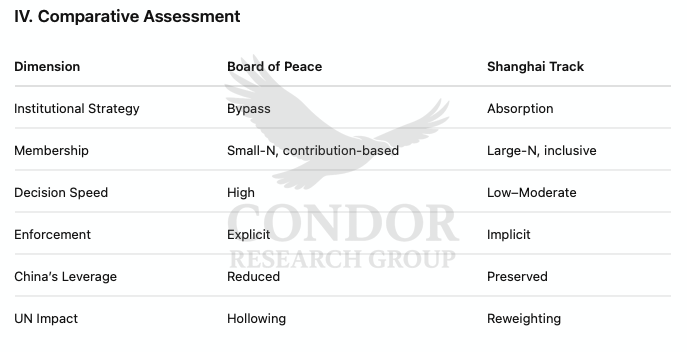
V. Predictions
Near Term (0–12 months)
- Symbolic Participation: One or more major powers publicly explore Board of Peace membership, conferring initial legitimacy.
- Chinese Hedging: Beijing intensifies Shanghai‑track diplomacy to preempt defections.
- UN Agenda Dilution: High‑salience issues increasingly addressed outside UN forums.
Mid Term (12–36 months)
- Partial Institutional Migration: 30–40 states utilize the Board of Peace for specific missions.
- Alliance Stress: Russia–China coordination becomes more transactional and less declarative.
- UN Functional Decline: Continued existence with reduced relevance on enforcement and reconstruction.
Long Term (36+ months)
- Dual‑Track Order: Coexistence of execution‑centric and norm‑centric institutions.
- China’s Choice Point: Join parallel mechanisms with reduced leverage or accept marginalization in high‑impact decisions.
- Normalization of Bypass: Institutional pluralism becomes the default feature of global governance.
VI. Conclusion
The emerging contest is not ideological but architectural. The Board of Peace challenges the assumption that universality equals legitimacy; the Shanghai track challenges the assumption that reform requires rupture. In practice, most states will not choose an order. They will use both, opportunistically and sequentially.
From a CRG perspective, the decisive variable is not formal membership but institutional gravity: where decisions that carry material consequences are actually made. As parallel mechanisms mature, the United Nations is unlikely to collapse. It is more likely to persist as a legitimizing theater while execution migrates elsewhere.
Both architectures should therefore be understood less as solutions than as liability-allocation devices. They determine which actors bear the cost of enforcement, reconstruction, and failure, and which actors merely arbitrate language.
The central question is not which order prevails, but which one inherits the debris of unresolved crises as institutional enforceability continues to decline. In that environment, bypass will outperform reform; until bypass itself becomes the next layer of inherited structure.
CRG assesses that parallel orders will define the next phase of global governance, with the UN transitioning from central platform to secondary arena rather than disappearing outright.
Appendix: Analyst Note — Second-Order Consequences
The emergence of parallel governance architectures introduces secondary effects that are not immediately visible at the level of formal diplomacy but are likely to shape behavior over time.
1. Funding Migration
As execution-centric mechanisms gain credibility, capital is likely to follow function rather than form. Reconstruction funds, stabilization financing, and private–public partnerships will preferentially route through institutions perceived as decisive and time-bounded. This creates a feedback loop: funding reinforces relevance, relevance attracts further funding. Legacy institutions may retain headline budgets while losing discretionary influence over high-impact deployments.
2. Legal Arbitrage
States and non-state actors will increasingly forum-shop between institutions to optimize outcomes. Normative disputes may remain within UN-linked frameworks, while enforcement-sensitive issues migrate to parallel bodies. Over time, this bifurcation risks hollowing out international law as a unified system, replacing it with a patchwork of venue-specific precedents and selective compliance.
3. Crisis Triage Behavior
Parallel orders incentivize triage rather than resolution. Crises deemed strategically consequential will be escalated into execution-capable forums; others will be managed rhetorically or indefinitely deferred. This introduces an implicit hierarchy of human and political emergencies, determined less by moral weight than by strategic utility and institutional bandwidth.
4. Institutional Precedent Risk
Once bypass becomes normalized, no institution retains permanent centrality. Each new mechanism inherits the same long-term fragility as the structures it supplants. The cumulative effect is not a stable alternative order, but accelerating institutional turnover.
Analytic Implication: Parallelism increases short-term effectiveness at the cost of long-term coherence. For states with high adaptive capacity, this is an advantage. For institutions built on universality and process, it represents a slow but structural erosion.
Document: CRG-INT-ANL-0126/4: Parallel Orders: The Board of Peace and the Shanghai Track
Revision status: Final – Approved for internal CRG circulation, external academic reference release and web release.
Authorized by: Condor Research Group (CRG) – Strategic Modeling
Date: 29 Jan 2026 – CRG-ANL-VER-A1-FINAL (web delayed, modified raw layout)
CRG-INT-ANL-0126/4
Prepared by: Condor Research Group (CRG)
Classification: Public Analysis
Date: January 2026
Executive Summary
Two competing approaches to post–UN global governance are now visible. The first, associated with former U.S. President Donald Trump, proposes a compact, contribution‑based framework; the Board of Peace, designed to bypass universalism in favor of execution and permanence through capital commitment. The second, associated with Beijing, advances a Shanghai‑anchored multilateral reform agenda via the Shanghai Cooperation Organisation (SCO) ecosystem and China’s broader Global Initiatives, preserving sovereignty‑centric multilateralism while incrementally reshaping norms.
This paper compares both approaches, maps likely supporters and institutional alignments, and offers near‑ and mid‑term predictions on institutional migration, alliance stress, and UN relevance.
Key Judgments
- The Board of Peace is an institutional bypass, not a reform. Its strategic utility lies in hollowing out UN relevance through parallel legitimacy.
- The Shanghai track is an institutional absorption strategy. It seeks to keep multilateralism intact while re‑weighting power toward the Global South under Chinese convening authority.
- Russia is structurally incentivized to explore the Board of Peace; China is structurally disincentivized—but pressured to hedge.
- Partial adoption (30–40 states) is sufficient to degrade UN agenda‑setting power without formal dissolution.
I. The Board of Peace: Design Logic and Strategic Intent
Core Design
- Membership Logic: Contribution‑based permanence (reported benchmark: USD 1B) paired with rotating, non‑paying participation.
- Institutional Scope: Peace, reconstruction, enforcement coordination; deliberately narrow to enable action.
- Governance: Small‑N decision‑making; no veto culture; emphasis on execution over consensus.
Strategic Intent
- Institutional Substitution: Create a credible venue that states can use instead of the UN when outcomes matter.
- Sanctions Reframing: Enable sanctioned or diplomatically isolated states to re‑enter global processes without UN mediation.
- Alliance Stress: Incentivize wedge dynamics—particularly between Moscow and Beijing—by altering payoff structures.
Implications
- The model privileges capital, speed, and alignment over universality and norm‑signaling.
- Legitimacy accrues through participation by major powers rather than moral consensus.
II. The Shanghai Track: Design Logic and Strategic Intent
Core Design
- Institutional Base: Shanghai Cooperation Organisation (SCO) plus China’s Global Development, Security, and Civilization Initiatives.
- Membership Logic: Broad, sovereignty‑centric multilateralism; no pay‑to‑enter thresholds.
- Governance: Consensus‑heavy, process‑oriented, norm‑generating.
Strategic Intent
- Institutional Absorption: Preserve multilateral structures while rebalancing influence toward non‑Western states.
- Lawfare & Norms: Maintain international law as a primary arena of competition.
- Risk Diffusion: Avoid sharp bifurcation by offering an inclusive alternative to Western‑led bodies.
Implications
- China retains agenda‑setting leverage and veto‑like influence through process and scale.
- The model is resilient but slow; legitimacy is broad, enforcement weak.
III. Supporting States and Organizational Alignment
Likely Board of Peace Supporters (Early Adopters)
- United States: Institutional sponsor; seeks leverage and execution.
- Russia: Incentivized by UN hostility and sanctions fatigue; strategic optionality.
- Selective Middle Powers: States prioritizing reconstruction outcomes over normative alignment (case‑by‑case).
- Private Capital & Reconstruction Consortia: Attracted to clear mandates and funding pathways.
Likely Shanghai Track Supporters
- China: Principal architect and convenor.
- SCO Core Members: Russia (hedging), Central Asian states, Pakistan; security‑economic alignment.
- Global South Coalitions: States favoring sovereignty protection and inclusive forums.
- BRICS‑Adjacent Institutions: Development banks and coordination platforms aligned with Chinese initiatives.
Swing States (Key Battleground)
- India: Strategic autonomy; selective participation likely.
- Gulf States: Pragmatic hedging; interest in execution without norm entanglement.
- Southeast Asia: Institutional pluralism; avoidance of binary alignment.
V. Predictions
Near Term (0–12 months)
- Symbolic Participation: One or more major powers publicly explore Board of Peace membership, conferring initial legitimacy.
- Chinese Hedging: Beijing intensifies Shanghai‑track diplomacy to preempt defections.
- UN Agenda Dilution: High‑salience issues increasingly addressed outside UN forums.
Mid Term (12–36 months)
- Partial Institutional Migration: 30–40 states utilize the Board of Peace for specific missions.
- Alliance Stress: Russia–China coordination becomes more transactional and less declarative.
- UN Functional Decline: Continued existence with reduced relevance on enforcement and reconstruction.
Long Term (36+ months)
- Dual‑Track Order: Coexistence of execution‑centric and norm‑centric institutions.
- China’s Choice Point: Join parallel mechanisms with reduced leverage or accept marginalization in high‑impact decisions.
- Normalization of Bypass: Institutional pluralism becomes the default feature of global governance.
VI. Conclusion
The emerging contest is not ideological but architectural. The Board of Peace challenges the assumption that universality equals legitimacy; the Shanghai track challenges the assumption that reform requires rupture. In practice, most states will not choose an order. They will use both, opportunistically and sequentially.
From a CRG perspective, the decisive variable is not formal membership but institutional gravity: where decisions that carry material consequences are actually made. As parallel mechanisms mature, the United Nations is unlikely to collapse. It is more likely to persist as a legitimizing theater while execution migrates elsewhere.
Both architectures should therefore be understood less as solutions than as liability-allocation devices. They determine which actors bear the cost of enforcement, reconstruction, and failure, and which actors merely arbitrate language.
The central question is not which order prevails, but which one inherits the debris of unresolved crises as institutional enforceability continues to decline. In that environment, bypass will outperform reform; until bypass itself becomes the next layer of inherited structure.
CRG assesses that parallel orders will define the next phase of global governance, with the UN transitioning from central platform to secondary arena rather than disappearing outright.
Appendix: Analyst Note — Second-Order Consequences
The emergence of parallel governance architectures introduces secondary effects that are not immediately visible at the level of formal diplomacy but are likely to shape behavior over time.
1. Funding Migration
As execution-centric mechanisms gain credibility, capital is likely to follow function rather than form. Reconstruction funds, stabilization financing, and private–public partnerships will preferentially route through institutions perceived as decisive and time-bounded. This creates a feedback loop: funding reinforces relevance, relevance attracts further funding. Legacy institutions may retain headline budgets while losing discretionary influence over high-impact deployments.
2. Legal Arbitrage
States and non-state actors will increasingly forum-shop between institutions to optimize outcomes. Normative disputes may remain within UN-linked frameworks, while enforcement-sensitive issues migrate to parallel bodies. Over time, this bifurcation risks hollowing out international law as a unified system, replacing it with a patchwork of venue-specific precedents and selective compliance.
3. Crisis Triage Behavior
Parallel orders incentivize triage rather than resolution. Crises deemed strategically consequential will be escalated into execution-capable forums; others will be managed rhetorically or indefinitely deferred. This introduces an implicit hierarchy of human and political emergencies, determined less by moral weight than by strategic utility and institutional bandwidth.
4. Institutional Precedent Risk
Once bypass becomes normalized, no institution retains permanent centrality. Each new mechanism inherits the same long-term fragility as the structures it supplants. The cumulative effect is not a stable alternative order, but accelerating institutional turnover.
Analytic Implication: Parallelism increases short-term effectiveness at the cost of long-term coherence. For states with high adaptive capacity, this is an advantage. For institutions built on universality and process, it represents a slow but structural erosion.
Document: CRG-INT-ANL-0126/4: Parallel Orders: The Board of Peace and the Shanghai Track
Revision status: Final – Approved for internal CRG circulation, external academic reference release and web release.
Authorized by: Condor Research Group (CRG) – Strategic Modeling
Date: 29 Jan 2026 – CRG-ANL-VER-A1-FINAL (web delayed, modified raw layout)