CRG-INT-NOTE-1025/2: Synthesis Note — Projected Casualty Bands and Operational Confidence
05/10/25 22:30
CRG-INT-NOTE-1025/2
Subject: Synthesis Note — Projected Casualty Bands and Operational Confidence, Iran Contingency (COAs A–D)
Date: 04 Oct 2025
Prepared by: Condor Research Group (CRG) — MEA Node
Audit Source — CRG-MEA-INT-0925/IRN-COA: Iran Contingency: From Stand-Off Punishment to Low-Probability Invasion (18 Sept 2025)
Extract:
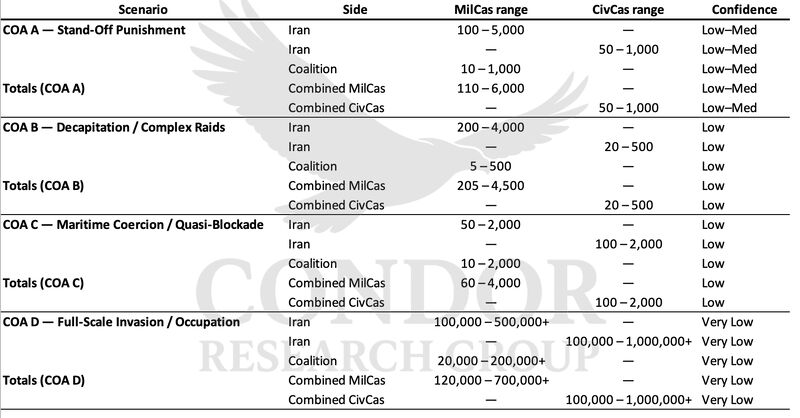
Casualty band modeling for U.S.–Israel coalition courses of action (COAs A–D) against Iran demonstrates that the kinetic footprint is inversely correlated with political plausibility. As escalation widens from limited punitive strikes to full-scale occupation, casualty bands expand by three orders of magnitude while confidence in analytic precision declines. The dataset functions both as an attrition model and as a proxy for escalation risk.
Summary:
- COA A — Stand-Off Punishment: Most probable pathway; limited PGM and UAV strikes on strategic targets.
- COA B — Decapitation / Complex Raids: Short-duration SOF and precision packages.
- COA C — Maritime Coercion / Quasi-Blockade: Low attrition steady-state with episodic spikes from ASCM or mine incidents.
- COA D — Full-Scale Invasion / Occupation: Bounding case.
The table illustrates how uncertainty rises faster than force commitment—operational complexity outpaces analytic resolution.
Assessment:
1. Cognitive Pattern:
Escalation beyond COA B produces decision-compression in Western command structures. Risk calculus shifts from proportionality to political survival.
2. Perceptual Distortion:
Casualty band expansion creates narrative inversion—data becomes rhetoric fuel. Each side claims precision while operating inside fog parameters of ±300%.
3. Institutional Risk:
Overconfidence in low-probability COA D models invites budgetary and diplomatic overreach. Casualty uncertainty translates into fiscal and reputational exposure.
4. Strategic Implication:
Sustained low-level conflict (A–C) remains the rational equilibrium. Occupation models (D) exist only as planning scaffolds and should not drive policy signaling.
Directive:
- Treat COA A and B bands as the analytic centerline for planning and logistics.
- Retain COA C metrics as energy and shipping risk indices for insurance and market forecasting.
- Archive COA D models under low-probability/high-impact doctrinal files; re-activate only upon multi-theater mobilization signals (sealift + reservist coefficient ≥ 90 days).
- Integrate casualty bands into regional energy disruption and inflation forecasts to support civil contingency planning.
Margin Note:
Precision shrinks as ambition grows. The numbers warn not of loss but of hubris.
———-
COA R — Iranian Retaliation on Israel: Civilian casualty ranges depend on the coalition’s initial strike success and are highly unpredictable. Best case: hundreds. Worst case: millions — given Iran’s extensive munitions inventory and proxy reach.
Subject: Synthesis Note — Projected Casualty Bands and Operational Confidence, Iran Contingency (COAs A–D)
Date: 04 Oct 2025
Prepared by: Condor Research Group (CRG) — MEA Node
Audit Source — CRG-MEA-INT-0925/IRN-COA: Iran Contingency: From Stand-Off Punishment to Low-Probability Invasion (18 Sept 2025)
Extract:
Casualty band modeling for U.S.–Israel coalition courses of action (COAs A–D) against Iran demonstrates that the kinetic footprint is inversely correlated with political plausibility. As escalation widens from limited punitive strikes to full-scale occupation, casualty bands expand by three orders of magnitude while confidence in analytic precision declines. The dataset functions both as an attrition model and as a proxy for escalation risk.
Summary:
- COA A — Stand-Off Punishment: Most probable pathway; limited PGM and UAV strikes on strategic targets.
- COA B — Decapitation / Complex Raids: Short-duration SOF and precision packages.
- COA C — Maritime Coercion / Quasi-Blockade: Low attrition steady-state with episodic spikes from ASCM or mine incidents.
- COA D — Full-Scale Invasion / Occupation: Bounding case.
The table illustrates how uncertainty rises faster than force commitment—operational complexity outpaces analytic resolution.
Assessment:
1. Cognitive Pattern:
Escalation beyond COA B produces decision-compression in Western command structures. Risk calculus shifts from proportionality to political survival.
2. Perceptual Distortion:
Casualty band expansion creates narrative inversion—data becomes rhetoric fuel. Each side claims precision while operating inside fog parameters of ±300%.
3. Institutional Risk:
Overconfidence in low-probability COA D models invites budgetary and diplomatic overreach. Casualty uncertainty translates into fiscal and reputational exposure.
4. Strategic Implication:
Sustained low-level conflict (A–C) remains the rational equilibrium. Occupation models (D) exist only as planning scaffolds and should not drive policy signaling.
Directive:
- Treat COA A and B bands as the analytic centerline for planning and logistics.
- Retain COA C metrics as energy and shipping risk indices for insurance and market forecasting.
- Archive COA D models under low-probability/high-impact doctrinal files; re-activate only upon multi-theater mobilization signals (sealift + reservist coefficient ≥ 90 days).
- Integrate casualty bands into regional energy disruption and inflation forecasts to support civil contingency planning.
Margin Note:
Precision shrinks as ambition grows. The numbers warn not of loss but of hubris.
———-
COA R — Iranian Retaliation on Israel: Civilian casualty ranges depend on the coalition’s initial strike success and are highly unpredictable. Best case: hundreds. Worst case: millions — given Iran’s extensive munitions inventory and proxy reach.