CRG-ASI-INT-1225: Triadic War Doctrine: Japan–China–Taiwan
Zulu timestamp: 2025-12-08 / 1531Z
0. Opening Frame: The System Has Entered Pre-War Logic
The Taiwan Strait is no longer a dyad (China–Taiwan).
It is a triadic conflict system with asymmetric escalation vectors:
- China (PRC) seeks closure: end of Taiwan’s autonomy, rollback of U.S.–Japan forward presence, restoration of regional hierarchy.
- Taiwan (ROC) seeks survival: asymmetric porcupine defence, internationalisation of its cause, endurance in the opening phase of any assault.
- Japan has crossed the psychological Rubicon: from a passive logistics node to a sovereign actor preparing for counter-strike warfare.
The system is unstable because:
1. Each side sees itself on the clock.
2. Each side believes escalation can be controlled.
3. All three are wrong.
This document models the first 2–10 weeks of a major Taiwan crisis and its potential emergence into a regional war involving precision strikes on Japanese bases, cyber-induced blackouts, orbital degradation operations, and semiconductor ecosystem collapse.
CRG’s position:
If the triad tips, Asia enters a 30-year structural fracture.
1. Triad Strategic Logic
1.1 China: Forced Decision Window
Drivers of Chinese impatience:
- Demographic inversion (accelerating aging, shrinking youth cohorts)
- U.S.–Japan rearmament
- Taiwan’s hardening political identity
- Semiconductor self-sufficiency still out of reach
- Internal legitimacy pressures in a slowing economy
China’s logic:
If Taiwan is to be taken intact, sooner is better.
If Taiwan is to be destroyed, anytime is acceptable.
PRC recognizes the following:
- A full invasion is costly but decisive.
- A blockade is less risky but slower.
- A Japan strike is a gamble — but may become necessary if Japan intervenes.
The strategic objective is the elimination of Taiwan as an independent political actor without triggering an uncontrollable U.S.–Japan alliance response.
China believes this can be done.
CRG modelling suggests they underestimate the system’s sensitivity.
1.2 Taiwan: Asymmetric Survival Doctrine
Taiwan’s actual doctrine is simple:
1. Do not collapse in the first 14 days.
2. Maintain a functioning government in the first 30 days.
3. Preserve semiconductor death-hand switch options.
4. Force Japan and the U.S. to commit in stages.
Its porcupine assets include:
- Mobile anti-ship missiles
- Shore-based anti-air batteries
- Distributed comms nodes
- Rapid minelaying capability
- Hardened C2 facilities
- Semiconductor chokepoint leverage (“If we fall, you fall with us”)
Its weaknesses:
- Geographic compression
- Dependence on imports
- Vulnerable power grid
- Limited depth for retreat
- Small active-duty force vs massed Chinese brigades
Taiwan does not need to win.
It needs to not lose fast.
1.3 Japan: The Sleeping Arsenal Awakens
Japan’s shift is structural, not political.
• Acquisition of counter-strike missiles
• Hardened bases on the Ryukyus
• Deepening U.S.–Japan command integration
• Legal reinterpretation of “existential threat” to include Taiwan
• Rising defence budgets and explicit planning for Taiwan contingencies
Japan cannot afford a Chinese Taiwan:
1. The first island chain collapses.
2. Chinese naval and air projection moves to Japan’s throat.
3. U.S.–Japan alliance credibility erodes.
4. Japan’s internal political right becomes unrestrained.
Thus:
Japan’s involvement is not optional under most major-war scenarios.
Once Japan enters, China’s escalation ceiling rises sharply.
2. Scenario Ladder (Full CRG Model)
CRG models conflict evolution as four primary archetypes with twelve sub-scenarios.
Scenario 1 — Grey Horizon (Non-War, Pre-War)
Slow strangulation, calibrated coercion.
Already unfolding:
- Constant Chinese air incursions
- Drone overflights
- Jamming of Taiwanese radar
- Cyber probing of Japanese infrastructure
- Carrier operations near Okinawa
- Radar lock-ons on Japanese F-15s
- Economic punishments
Japan responds:
- Hardening bases
- Diversifying supply chains
- Quietly training for Taiwan landing response
- Hosting more U.S. assets
Escalation trigger: Mid-air collision or misinterpreted radar spike.
Outcome: No big war; but no peace.
The system corrodes until something breaks.
Scenario 2 — Lights Out Blockade
The dark strategy: Strangle Taiwan without a shot.
China declares “quarantine zones” and harasses shipping.
Phase structure:
Phase 1 (Week 0–2):
- Cyberattacks on Taiwan’s grid
- Downing of selected satellites via dazzling / cyber-injection
- Insurance shock for commercial shipping
- Missile “tests” across Taiwan airspace
Phase 2 (Week 2–8):
- Boarding attempts
- No-fly enforcement over select lanes
- Taiwan loses 30–50% import capacity
- Semiconductor output halts due to logistics interruption
Phase 3 (Week 8+):
- U.S.–Japan must decide:
Accept Taiwan’s collapse or break the blockade?
Blockade-breaking = de facto war.
If convoys begin, China reserves the right to:
- Strike maritime escorts
- Strike Japanese ports supporting them
- Blind GPS and BeiDou in the theatre
- Jam satellite uplinks over Okinawa and Taiwan
This is where war becomes inevitable.
Scenario 3 — Full Invasion with Japan in the Fight
The darkest path.
China launches:
1. Opening missile storm (1,500–3,000 ballistic + cruise missiles)
2. Decapitation strikes on leadership and C2
3. Suppression of air defences
4. Cyber blackout
5. Amphibious waves toward west coast beaches
Japan is struck early — because China assumes Japanese bases will support U.S. sorties.
Japan’s southwest islands are hit with:
- DF-17 hypersonics
- Saturation volleys of cruise missiles
- Precision strikes on radars, fuel farms, and ports
The U.S. responds:
- Submarine-launched anti-ship strikes
- Long-range bomber attacks
- Space-based reconnaissance
- Electronic warfare suppression of PLA kill chain
Taiwan’s porcupine grid engages landing craft and beachheads.
Outcome band:
- PLA lodgment fails (best case)
- PLA secures partial beachhead (worst case)
- Semiconductor infrastructure is partly destroyed or scorched deliberately
- Regional economy collapses for 3–10 years
This is the true nightmare scenario.
Scenario 4 — Ryukyu Knife-Edge
China–Japan direct clash, Taiwan in the background.
This arises when:
- PRC uses Taiwan operation as pretext to assert control near Miyako/Okinawa
- Japan intercepts
- Shots are exchanged
This can evolve into:
- Limited air war
- Strikes on Japanese bases
- No invasion of Taiwan, but Taiwan collapses politically under shock
China prefers this scenario if it believes Japan can be cowed by pain.
Japan prefers escalation if it believes Chinese expansion must be stopped early.
Both sides risk miscalculation.
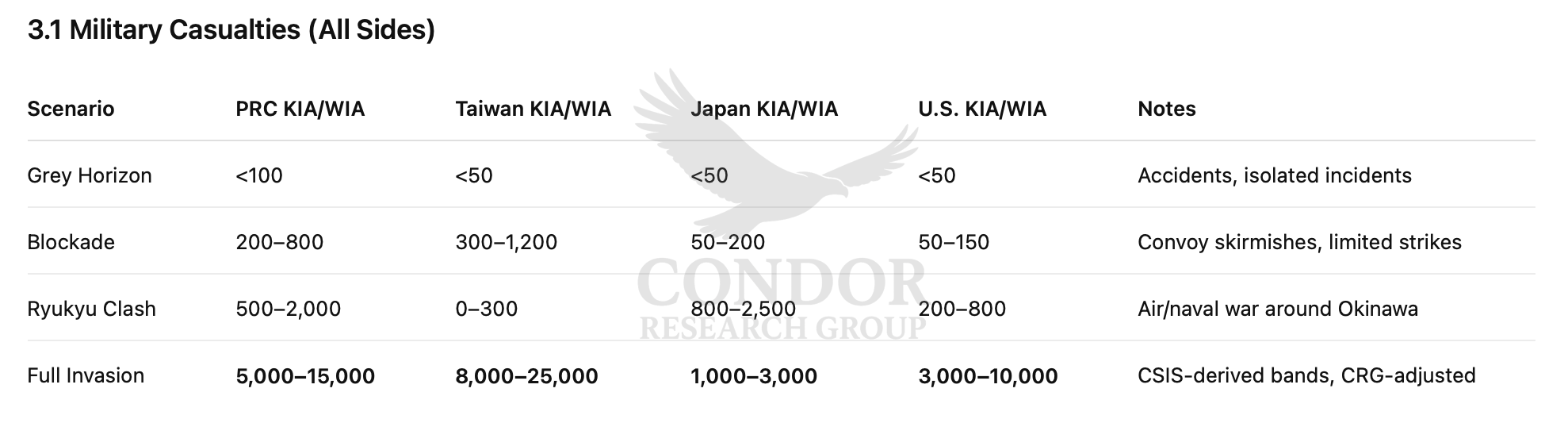
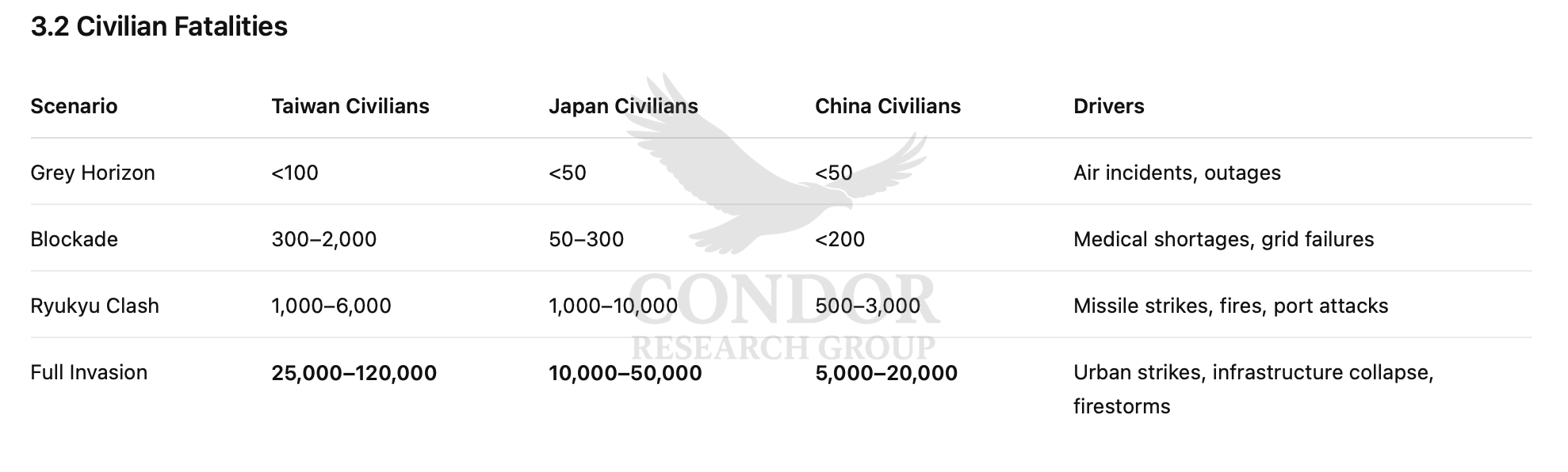
3. Expanded CRG Casualty & Damage Tables (Full Dark Edition)
These tables extend the earlier draft with:
- Kill-chain collapse modelling
- Long-war infrastructure attrition
- Semiconductor ecosystem loss
- Breakdown of civilian vs military fatality bands
- Orbital and cyber collateral metrics
Values represent the first 2–10 weeks.
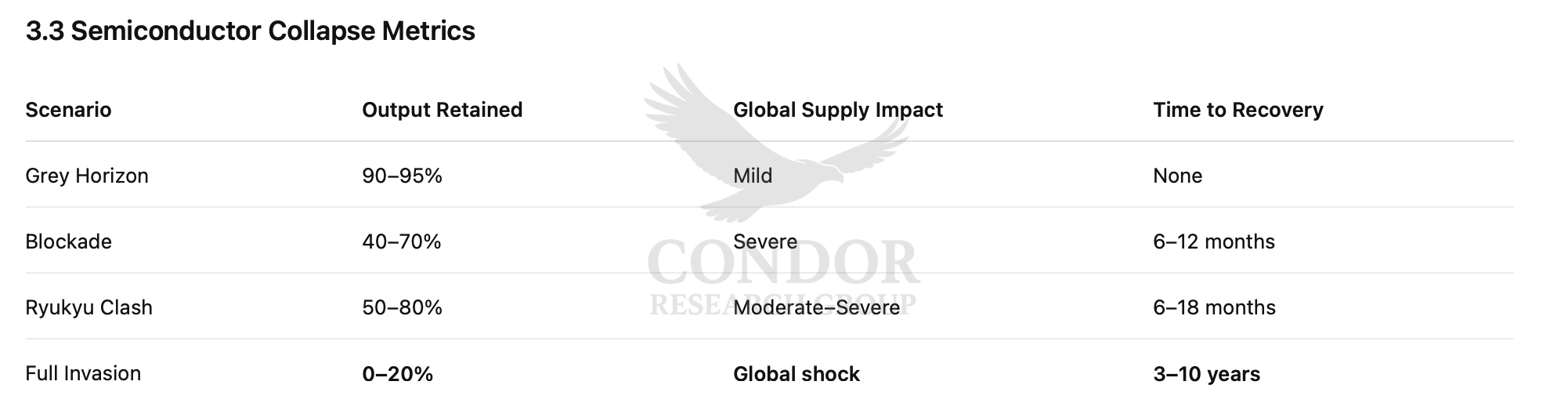
Taiwan’s fabs cannot operate without:
- Chemical imports
- Power stability
- Uninterrupted logistics
- Staff presence
Invasion or precision strikes = global semiconductor depression.
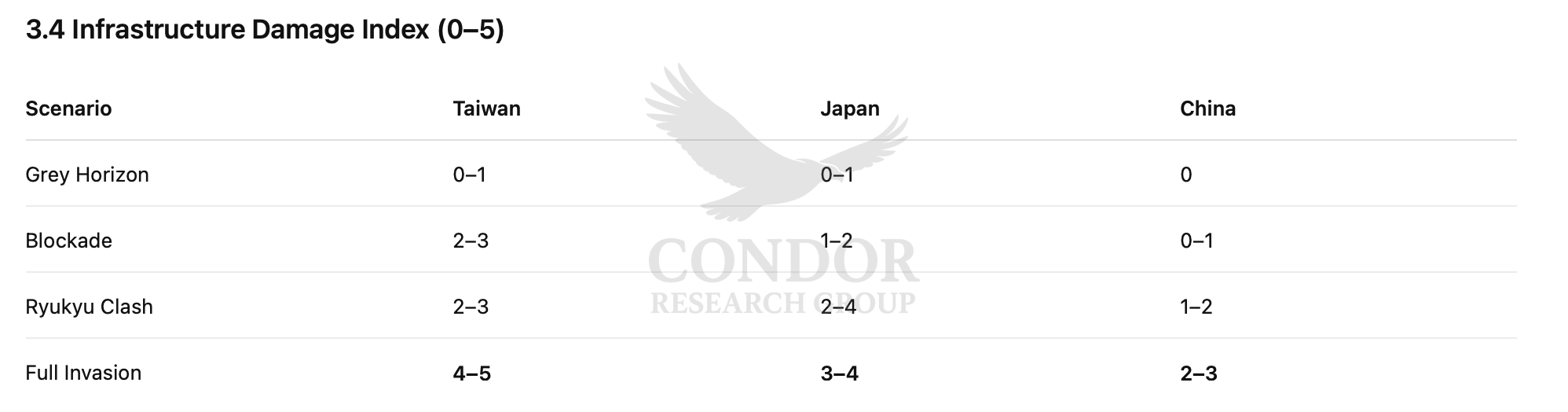
Scale Interpretation:
0 – No meaningful infrastructure impact
1 – Localised disruption; rapid repair possible
2 – Sustained degradation in select regions or sectors
3 – National-level strain; rolling outages, logistics bottlenecks
4 – Systemic failure across multiple sectors
5 – Near-total collapse of national infrastructure function
Taiwan suffers catastrophic grid collapse under invasion.
Japan’s southwest islands sustain heavy missile-strike damage.
3.5 Orbital Warfare & Kill Chain Collapse
Likely actions:
- Cyber-induced sensor misreads
- Dazzling/blinding of LEO reconnaissance satellites
- Interference with GPS/BeiDou in theatre
- Spoofed targeting data
- Uplink jamming against Japanese and U.S. satellites
Impacts:
- Missile accuracy degradation of 10–40%
- Loss of ISR over parts of East China Sea
- Increased risk of fratricide and accidental escalation
- Possible Kessler-like debris bursts (if kinetic ASATs used)
If kinetic ASATs are used, orbital degradation becomes permanent.
4. Degradation Curves: How Societies Begin to Break
4.1 Taiwan (Worst Case)
Within 21 days:
- 50–70% of grid offline
- Water pumping capacity reduced 40%
- Hospital system in crisis
- Semiconductor fabs halted
- Food imports disrupted
- Telecommunications reduced to 20–40% capacity
Public order becomes fragile.
4.2 Japan
Within 30–60 days of war:
- Fuel shortages in southwest islands
- Port capacity reduced due to strikes
- 10–15% of population experiences intermittent blackouts
- Major economic contraction
- Rising nationalist mobilisation
- Risk of anti-China domestic violence
Japan can absorb enormous pain, but it becomes transformed.
4.3 China
Within 60–120 days:
- Technology imports collapse
- Regional unemployment surges
- Domestic unrest risk rises
- PLA attrition affects morale
- International sanctions choke logistics
- Currency instability possible
China can survive a short war.
A long war becomes structurally dangerous.
5. End-State Constellations
A. “Shattered Victory” (Taiwan survives)
- China fails to secure lasting lodgment
- Japan emerges as a hard power
- U.S.–Japan alliance strengthened
- China politically wounded
- Taiwan devastated but autonomous
- Semiconductor ecosystem fractured
B. “The Silent Annexation” (Taiwan collapses)
- China wins without formal invasion
- Japan humiliated
- U.S. credibility wounded
- East Asian hierarchy rewritten
C. “The Ashen Triangle” (Mutual destruction)
- Taiwan becomes battlefield ruins
- Japan heavily damaged
- China destabilised
- Economy of Asia shattered
CRG probability (2025–2030):
- Grey Horizon: 55%
- Blockade: 25%
- Ryukyu Clash: 15%
- Full Invasion: 5%, but climbing
6. CRG Closing Doctrine
A war in the Taiwan Strait is not about Taiwan.
It is about the architecture of Asia.
If the triad fractures, the century fractures with it.
China believes it can force an outcome.
Japan believes it can contain one.
Taiwan believes it can delay one.
CRG’s assessment:
No actor fully controls the ladder.
All three are tied to the same fuse.
The moment escalation begins, the system transitions from
statecraft → attrition → entropy
with each rung harder to reverse.
This is the most dangerous triad on Earth.