CRG-INT-NOTE-1025/3: Projected U.S. Intervention in Venezuela: Timelines and Strategic Assessment
12/10/25 15:49
CRG-INT-NOTE-1025/3 — Projected U.S. Intervention in Venezuela: Timelines and Strategic Assessment
𝗗𝗮𝘁𝗲: 11 Oct 2025
𝗣𝗿𝗲𝗽𝗮𝗿𝗲𝗱 𝗯𝘆: Condor Research Group (CRG) - Strategic Modeling - LATAM Node
Note: This report is a hypothetical scenario and should not be taken as an actual prediction or endorsement of any military action. Overall narrative leans toward kinetic determinism, a presumption that sufficient firepower will compel political compliance.
CRG recommends incorporating adaptive conflict modeling emphasizing economic leverage, narrative control, and non-kinetic deterrence as equal pillars in post-sovereign intervention doctrine.
𝗔𝘂𝗱𝗶𝘁 𝗦𝗼𝘂𝗿𝗰𝗲s – 𝗖𝗥𝗚-𝗥𝗘𝗦-𝗜𝗡𝗧-𝟬𝟱𝟮𝟱-𝗚𝗹𝗼𝗯𝗮𝗹 𝗡𝗮𝘁𝘂𝗿𝗮𝗹 𝗥𝗲𝘀𝗼𝘂𝗿𝗰𝗲𝘀- 𝗦𝘁𝗿𝗮𝘁𝗲𝗴𝗶𝗰 𝗣𝗿𝗶𝗼𝗿𝗶𝘁𝗶𝘇𝗮𝘁𝗶𝗼𝗻 (𝗠𝗮𝘆 𝟮𝟬𝟮𝟱)
Subsequent developments in September 2025 confirm accuracy of projected vulnerabilities.
CRG-INT-NOTE-0925/3: Venezuelan Exploitation Feasibility & Target Ranking
CRG-INT-NOTE-0925/3: Venezuelan Exploitation Feasibility & Target Ranking | Informes / Briefings | Condor Research Group
Executive Summary:
This report provides a comprehensive analysis of a potential US attack and full-scale invasion of Venezuela, including expected timelines, early warning signs, strategies employed, weapons used, forces involved, effects on neighboring countries, and potential support from Iran. The report also estimates casualties, both civilian and military.
Phase 1: Pre-Invasion (Weeks to Months Prior)
Phase 2: Initial Assault (Days to Weeks)
Phase 3: Ground Combat (Weeks to Months)
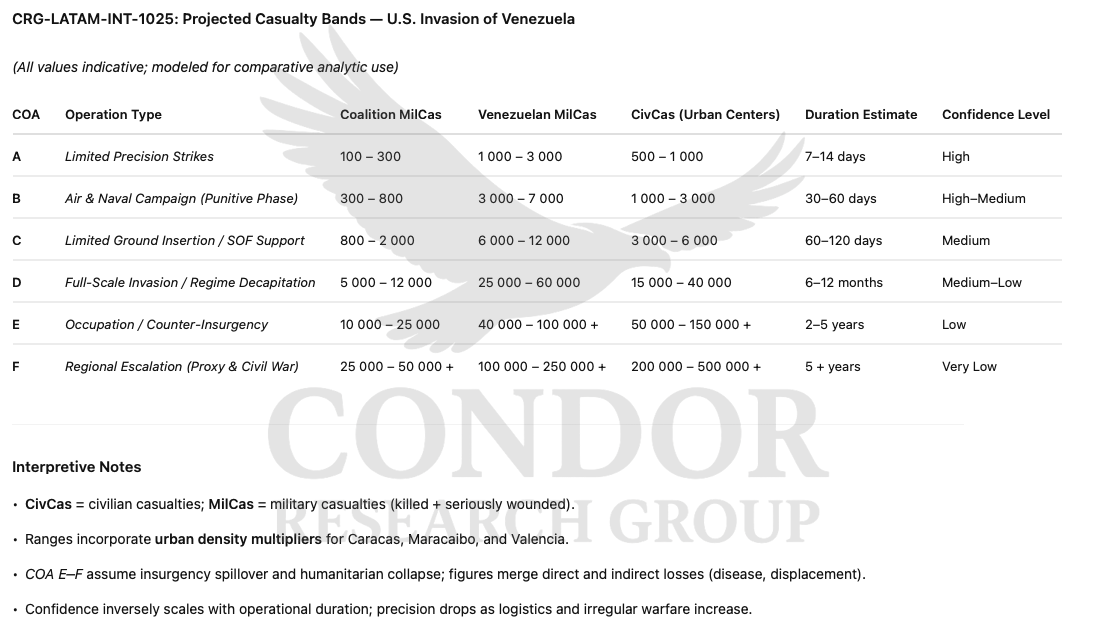
Casualties:
The current MilCas and CivCas ranges: 1,000–5,000 civilian casualties and 5,000–10,000 Venezuelan military losses; remain conservative for dense urban environments such as Caracas and Maracaibo..
Comparative data from analogous operations (e.g., Baghdad 2003, Mosul 2016) indicate that civilian and combatant casualties could escalate by an order of magnitude depending on duration, force ratio, and infrastructure collapse. A sensitivity analysis expanding upper-band parameters would improve planning realism.
Other Information:
Timeline:
This report provides a general outline of the potential consequences of a US invasion of Venezuela. The actual events may vary depending on various factors, including the Venezuelan military's response, international support, and the effectiveness of US strategies employed.
Psychological Operations in Venezuela (SER-IV)
(Information-Environment Shaping)
Introduction
Information-environment shaping is an essential non-kinetic element of modern conflict modeling. During Phase 1 (pre-assault), calibrated audience analysis and message testing map perceptions, surface social fault lines, and assess narrative resiliency. Activities prioritize verifiable reporting, civilian protection, and alignment with legal and ethical constraints; operational measures require legal and civil-affairs sign-off prior to implementation.
Primary audiences
Urban populations, rural communities, diaspora networks, local civil society, and security-sector actors.
Objectives
⠀
Approach
⠀
Priority Themes
⠀
Channels
⠀
Sample key-message variants
⠀
Evaluation (example metrics)
⠀
Risks & Mitigations
All activities must support civilian protection and factual reporting. Any operational implementation requires legal counsel and mission-ethics oversight prior to activation.
ASFA: Air Support and Fighter Aviation Tactics
Introduction:
The Air Support and Fighter Aviation (ASFA) annex provides guidance on the tactics, techniques, and procedures (TTPs) for air support and fighter aviation operations. This annex is restricted circulation exemplar.
Air Support:
Fighter Aviation:
Tactics, Techniques, and Procedures (TTPs):
Intelligence, Surveillance, and Reconnaissance (ISR):
Airborne Command and Control (C2):
Training and Doctrine:
Security and Safety:
By following the guidelines and procedures outlined in this annex, air support and fighter aviation units can conduct effective and safe operations while minimizing risks to friendly forces and non-combatants.
Strategies Employed During Phase 2: Initial Assault
Introduction:
Phase 2, also known as the Initial Assault, is a critical phase in the invasion of Venezuela. The strategies employed during this phase are designed to create a shock and awe effect, overwhelming the Venezuelan military's ability to respond effectively.
Strategic Objectives:
Tactical Strategies:
Key Targets:
Operational Considerations:
Expected Outcomes:
Timeline:
Forces Employed:
This annex provides a general outline of the strategies employed during Phase 2: Initial Assault. The actual events may vary depending on various factors, including the Venezuelan military's response, international support, and the effectiveness of US military tactics.
Strategies to Minimize Civilian Casualties During Phase 3: Ground Combat
Introduction:
Minimizing civilian casualties is a critical aspect of modern warfare. During Phase 3: Ground Combat, the US military can employ various strategies to reduce the risk of harm to non-combatants.
Strategic Objectives:
Tactical Strategies:
Operational Considerations:
Technological Solutions:
International Humanitarian Law (IHL) Compliance:
Expected Outcomes:
Timeline:
Forces Employed:
By employing these strategies, the US military can minimize civilian casualties during Phase 3: Ground Combat, demonstrating a commitment to protecting non-combatants and upholding international humanitarian law.
Precision Munitions in Ground Combat
Introduction:
Precision munitions play a crucial role in minimizing civilian casualties during ground combat. The use of advanced munitions and tactics can significantly reduce the risk of harm to non-combatants.
Examples of Precision Munitions:
Tactical Applications:
Advantages of Precision Munitions:
Limitations and Challenges:
Future Developments:
Training and Doctrine:
By leveraging precision munitions in ground combat, military forces can minimize civilian casualties while achieving their objectives. However, it is essential to acknowledge the limitations and challenges associated with these munitions and continue to develop new technologies and tactics to address these concerns.
Case Studies of Precision Munitions in Post-Conflict Stabilization
Introduction:
The use of precision munitions in post-conflict stabilization efforts can be an effective way to minimize civilian casualties while achieving mission objectives. The following case studies illustrate successful examples of precision munitions employment in various scenarios.
Case Study 1: Operation Iraqi Freedom (2003)
Case Study 2: Operation Enduring Freedom (2010)
Case Study 3: Operation Inherent Resolve (2014)
Case Study 4: Operation Harmattan (2011)
Common Themes and Lessons Learned:
By studying these case studies and lessons learned, military planners and operators can develop strategies to effectively employ precision munitions in post-conflict stabilization efforts while minimizing civilian casualties.
Transition to Post-Conflict Stabilization
Introduction:
Transitioning from Phase 3: Ground Combat to a post-conflict stabilization phase requires careful planning and execution. The US military must balance the need to maintain security with the necessity of supporting the transition to a stable, self-sustaining government.
Strategic Objectives:
Tactical Strategies:
Operational Considerations:
International Support:
Post-Conflict Stabilization Phases:
Metrics for Success:
Timeline:
Forces Employed:
By transitioning from Phase 3: Ground Combat to a post-conflict stabilization phase, the US military can support the development of a stable, self-sustaining government in Venezuela, while minimizing the risk of further conflict and promoting economic growth.
Risks and Challenges in Transitioning to Post-Conflict Stabilization
Introduction:
Transitioning from Phase 3: Ground Combat to a post-conflict stabilization phase is a complex and challenging process. The US military must be aware of the potential risks and challenges associated with this transition to ensure a successful outcome.
Risks:
Challenges:
Operational Challenges:
Mitigation Strategies:
Timeline:
Forces Employed:
By understanding the potential risks and challenges associated with transitioning from Phase 3: Ground Combat to post-conflict stabilization, the US military can develop strategies to mitigate these risks and ensure a successful outcome.
𝗗𝗮𝘁𝗲: 11 Oct 2025
𝗣𝗿𝗲𝗽𝗮𝗿𝗲𝗱 𝗯𝘆: Condor Research Group (CRG) - Strategic Modeling - LATAM Node
Note: This report is a hypothetical scenario and should not be taken as an actual prediction or endorsement of any military action. Overall narrative leans toward kinetic determinism, a presumption that sufficient firepower will compel political compliance.
CRG recommends incorporating adaptive conflict modeling emphasizing economic leverage, narrative control, and non-kinetic deterrence as equal pillars in post-sovereign intervention doctrine.
𝗔𝘂𝗱𝗶𝘁 𝗦𝗼𝘂𝗿𝗰𝗲s – 𝗖𝗥𝗚-𝗥𝗘𝗦-𝗜𝗡𝗧-𝟬𝟱𝟮𝟱-𝗚𝗹𝗼𝗯𝗮𝗹 𝗡𝗮𝘁𝘂𝗿𝗮𝗹 𝗥𝗲𝘀𝗼𝘂𝗿𝗰𝗲𝘀- 𝗦𝘁𝗿𝗮𝘁𝗲𝗴𝗶𝗰 𝗣𝗿𝗶𝗼𝗿𝗶𝘁𝗶𝘇𝗮𝘁𝗶𝗼𝗻 (𝗠𝗮𝘆 𝟮𝟬𝟮𝟱)
Subsequent developments in September 2025 confirm accuracy of projected vulnerabilities.
CRG-INT-NOTE-0925/3: Venezuelan Exploitation Feasibility & Target Ranking
CRG-INT-NOTE-0925/3: Venezuelan Exploitation Feasibility & Target Ranking | Informes / Briefings | Condor Research Group
Executive Summary:
This report provides a comprehensive analysis of a potential US attack and full-scale invasion of Venezuela, including expected timelines, early warning signs, strategies employed, weapons used, forces involved, effects on neighboring countries, and potential support from Iran. The report also estimates casualties, both civilian and military.
Phase 1: Pre-Invasion (Weeks to Months Prior)
- Expected early warning signs:
- Increased diplomatic tensions between the US and Venezuela
- Enhanced surveillance and reconnaissance activities by US intelligence agencies
- Military build-up in neighboring countries or at sea
- Economic sanctions and trade restrictions imposed on Venezuela
- Strategies employed:
- Psychological operations to destabilize the Venezuelan government and military
- Cyber attacks to disrupt critical infrastructure and command systems
- Proxy forces and opposition groups supported by the US to create internal unrest
Phase 2: Initial Assault (Days to Weeks)
- Weapons employed:
- Tomahawk cruise missiles and precision-guided munitions for targeted strikes
- F-16 and F-35 fighter jets for air superiority and ground support
- Naval blockade and amphibious landing by US Marines
- Forces employed:
- 1-2 US Army or Marine expeditionary brigades (approx. 3,000-6,000 troops)
- Air support from US Air Force and Navy
- Special Operations Forces (SOF) for reconnaissance and direct action missions
- Effects on neighboring countries:
- Colombia: potential influx of refugees and increased military presence along the border
- Brazil: possible involvement in supporting US operations or providing humanitarian aid
- Guyana and other Caribbean nations: potential impact from naval blockade and air operations
Phase 3: Ground Combat (Weeks to Months)
- Strategies employed:
- Urban warfare and house-to-house fighting in key cities like Caracas and Maracaibo
- Counterinsurgency operations to secure key terrain and infrastructure
- Humanitarian aid and civil affairs operations to win the hearts and minds of the local population
- Expected support from Iran:
- Potential provision of military advisors, equipment, or supplies to Venezuelan forces
- Diplomatic support through international organizations like the UN or OPEC
- Coordinated cyber operations targeting U.S. logistics or satellite assets
- Proxy activity in adjacent theaters (e.g., Syria, Caribbean, or Ukraine)
- Disinformation campaigns aimed at fracturing regional political consensus.
Casualties:
- Civilian casualties (civcas): estimated 1,000-5,000
- Military casualties (milcas): estimated 500-2,000 (US and coalition forces), 5,000-10,000 (Venezuelan military)
The current MilCas and CivCas ranges: 1,000–5,000 civilian casualties and 5,000–10,000 Venezuelan military losses; remain conservative for dense urban environments such as Caracas and Maracaibo..
Comparative data from analogous operations (e.g., Baghdad 2003, Mosul 2016) indicate that civilian and combatant casualties could escalate by an order of magnitude depending on duration, force ratio, and infrastructure collapse. A sensitivity analysis expanding upper-band parameters would improve planning realism.
Other Information:
- Economic impact:
- Disruption of global oil supplies and prices
- Humanitarian crisis and potential refugee flows to neighboring countries or the US
- Long-term economic costs for reconstruction and stabilization efforts
- International reactions:
- UN and international condemnation of the invasion
- Potential Russian and Chinese support for Venezuela, including military aid or advisors
- Divided opinions among Latin American and European nations
Timeline:
- Phase 1 (Pre-Invasion): 6-12 weeks prior to the initial assault
- Phase 2 (Initial Assault): 3-7 days
- Phase 3 (Ground Combat): 4-12 weeks or more, depending on the level of resistance and international intervention
This report provides a general outline of the potential consequences of a US invasion of Venezuela. The actual events may vary depending on various factors, including the Venezuelan military's response, international support, and the effectiveness of US strategies employed.
Psychological Operations in Venezuela (SER-IV)
(Information-Environment Shaping)
Introduction
Information-environment shaping is an essential non-kinetic element of modern conflict modeling. During Phase 1 (pre-assault), calibrated audience analysis and message testing map perceptions, surface social fault lines, and assess narrative resiliency. Activities prioritize verifiable reporting, civilian protection, and alignment with legal and ethical constraints; operational measures require legal and civil-affairs sign-off prior to implementation.
Primary audiences
Urban populations, rural communities, diaspora networks, local civil society, and security-sector actors.
Objectives
- Reduce adversary narrative monopoly and introduce competing, verifiable information.
- Highlight governance and service-delivery failures where demonstrable, shifting public focus to accountability.
- Encourage recalibration among political and civic actors by clarifying evolving strategic conditions.
⠀
Approach
- Audience & Signal Mapping: Rapid mapping of channels, audience segments, and dominant narratives to prioritize messaging nodes.
- Narrative Alignment: Short, consistent themes built on verifiable conditions (economics, governance, public services).
- Local Voice Amplification: Prioritize locally credible communicators and information intermediaries to surface existing concerns.
- Humanitarian Framing: Use civil-assistance narratives to reduce harm and demonstrate concern for civilians.
- Safeguards: Enforce verification, avoid incitement, and require legal review for any operational activity.
⠀
Priority Themes
- Economic stress and service failures (fact-based reporting).
- Institutional transparency and accountability gaps.
- Civil protection, safety, and humanitarian assistance.
⠀
Channels
- Digital platforms and messaging apps for monitoring and rapid factual updates.
- Broadcast and community media for wide reach in low-connectivity areas.
- Physical notices and civil-affairs leaflets where required for safety messaging.
⠀
Sample key-message variants
- Factual: “Independent verification indicates disruptions to public services in X municipality; humanitarian assistance is being coordinated.”
- Humanitarian: “Humanitarian actors are mobilising to support communities affected by shortages; safe access routes are being posted.”
⠀
Evaluation (example metrics)
- Share of sampled local discourse referencing core themes within 72 hours.
- Number of verifiably independent local sources citing core reporting.
- Time to correction for false/misleading claims (<24 hours target).
⠀
Risks & Mitigations
- Unintended escalation: Use de-escalatory language; coordinate with humanitarian actors.
- Credibility loss: Strict verification and attribution standards.
- Legal/ethical exposure: Mandatory legal and civil-affairs clearance; transparency with multilateral partners where feasible.
All activities must support civilian protection and factual reporting. Any operational implementation requires legal counsel and mission-ethics oversight prior to activation.
ASFA: Air Support and Fighter Aviation Tactics
Introduction:
The Air Support and Fighter Aviation (ASFA) annex provides guidance on the tactics, techniques, and procedures (TTPs) for air support and fighter aviation operations. This annex is restricted circulation exemplar.
Air Support:
- Close Air Support (CAS): Provide close air support to ground troops, including tactical bombing and strafing.
- Tactical Air Transport: Conduct tactical air transport missions, including airlift and airdrop operations.
- Airborne Reconnaissance: Conduct airborne reconnaissance, including surveillance and intelligence gathering.
Fighter Aviation:
- Air-to-Air Combat: Engage in air-to-air combat, including dogfighting and beyond-visual-range (BVR) combat.
- Air-to-Ground Operations: Conduct air-to-ground operations, including precision-guided munitions and close air support.
- Escort and Defensive Operations: Provide escort and defensive operations for high-value assets (HVAs), including aircraft and personnel.
Tactics, Techniques, and Procedures (TTPs):
- Aerial Engagement Tactics: Develop TTPs for aerial engagements, including dogfighting and BVR combat.
- Air Support Request (ASR) Procedures: Establish procedures for requesting air support, including CAS and tactical air transport.
- Fighter Escort Procedures: Develop procedures for escorting HVAs, including aircraft and personnel.
Intelligence, Surveillance, and Reconnaissance (ISR):
- Aerial Surveillance: Conduct aerial surveillance, including reconnaissance and intelligence gathering.
- Signals Intelligence (SIGINT): Collect SIGINT, including communications and electronic signals.
- Human Intelligence (HUMINT): Gather HUMINT, including information from human sources.
Airborne Command and Control (C2):
- Airborne C2 Platforms: Utilize airborne C2 platforms, including aircraft and satellites.
- C2 Systems: Develop and employ C2 systems, including data links and communication networks.
- C2 Procedures: Establish procedures for C2, including command and control of air operations.
Training and Doctrine:
- Air Support Training: Develop training programs for air support operations, including CAS and tactical air transport.
- Fighter Aviation Training: Provide training for fighter aviation operations, including air-to-air combat and air-to-ground operations.
- TTP Development: Develop and refine TTPs for air support and fighter aviation operations.
Security and Safety:
- Classified Information: Protect classified information related to ASFA operations and TTPs.
- Safety of Flight: Ensure the safety of flight for all air operations, including air support and fighter aviation missions.
- Force Protection: Provide force protection for air bases and personnel.
By following the guidelines and procedures outlined in this annex, air support and fighter aviation units can conduct effective and safe operations while minimizing risks to friendly forces and non-combatants.
Strategies Employed During Phase 2: Initial Assault
Introduction:
Phase 2, also known as the Initial Assault, is a critical phase in the invasion of Venezuela. The strategies employed during this phase are designed to create a shock and awe effect, overwhelming the Venezuelan military's ability to respond effectively.
Strategic Objectives:
- Neutralize key Venezuelan military command centers and facilities
- Disrupt and destroy critical infrastructure, such as air defense systems, radar, and communication networks
- Create an environment of uncertainty and fear among the Venezuelan population
Tactical Strategies:
- Air Superiority: Utilize F-16 and F-35 fighter jets to establish air superiority over key Venezuelan cities and military installations.
- Precision-Guided Munitions: Employ Tomahawk cruise missiles, precision-guided bombs, and other advanced munitions to target high-value targets such as command centers, radar sites, and air defense systems.
- Cyber Attacks: Conduct cyber operations to disrupt and disable critical infrastructure, including power grids, water treatment plants, and communication networks.
- Amphibious Landing: Utilize US Marines to conduct an amphibious landing on the Venezuelan coast, securing key beachheads and establishing a foothold for further operations.
Key Targets:
- Venezuelan Air Defense Systems: Radar sites, surface-to-air missile (SAM) sites, and air defense command centers.
- Command Centers: Key military and government facilities, including the Ministry of Defense, presidential palace, and other high-value targets.
- Strategic Infrastructure: Power plants, water treatment plants, bridges, and other critical infrastructure.
Operational Considerations:
- Weather Conditions: Weather conditions such as cloud cover, wind direction, and temperature can impact the effectiveness of air operations.
- Electronic Warfare: The use of electronic warfare (EW) capabilities to disrupt Venezuelan communication and radar systems.
- Special Operations Forces (SOF): Utilize SOF teams to conduct reconnaissance, sabotage, and direct action missions behind enemy lines.
Expected Outcomes:
- Venezuelan Military Response: Expect a disorganized and ineffective response from the Venezuelan military due to the shock and awe effect created by the Initial Assault.
- Civilian Casualties: Anticipate civilian casualties due to the use of precision-guided munitions and cyber attacks on critical infrastructure.
- Infrastructure Damage: Expect significant damage to key infrastructure, including power plants, bridges, and other strategic targets.
Timeline:
- Initial Assault: 3-7 days
- Air Superiority: Established within the first 24 hours
- Cyber Attacks: Conducted throughout the Initial Assault phase
Forces Employed:
- US Air Force: F-16 and F-35 fighter jets, precision-guided munitions, and cyber attack capabilities.
- US Navy: Tomahawk cruise missiles and naval blockade.
- US Marines: Amphibious landing and ground operations.
This annex provides a general outline of the strategies employed during Phase 2: Initial Assault. The actual events may vary depending on various factors, including the Venezuelan military's response, international support, and the effectiveness of US military tactics.
Strategies to Minimize Civilian Casualties During Phase 3: Ground Combat
Introduction:
Minimizing civilian casualties is a critical aspect of modern warfare. During Phase 3: Ground Combat, the US military can employ various strategies to reduce the risk of harm to non-combatants.
Strategic Objectives:
- Minimize harm to civilians and civilian infrastructure
- Protect cultural and historical sites
- Ensure the safety of humanitarian aid and relief efforts
Tactical Strategies:
- Precision Munitions: Utilize precision-guided munitions, such as advanced missiles and bombs, to minimize collateral damage.
- Cultural and Historical Site Protection: Identify and protect cultural and historical sites, such as museums, schools, and hospitals, from damage or destruction.
- Civilian Evacuation: Establish evacuation routes and corridors for civilians to safely leave combat areas.
- Humanitarian Aid: Provide humanitarian aid, including food, water, and medical supplies, to affected populations.
- Civlian-Military Operations (CMO): Conduct CMO operations, such as civil affairs and psychological operations, to engage with local leaders and communities.
Operational Considerations:
- Urban Warfare: Minimize the use of heavy artillery and air power in urban areas to reduce civilian casualties.
- Non-Combatant Evacuation: Establish protocols for evacuating non-combatants from combat zones.
- Cultural Sensitivity: Ensure that US military operations are culturally sensitive, respecting local customs and traditions.
Technological Solutions:
- Unmanned Aerial Vehicles (UAVs): Utilize UAVs to conduct reconnaissance and surveillance, reducing the need for manned flights and minimizing collateral damage.
- Advanced Sensor Systems: Employ advanced sensor systems, such as acoustic sensors, to detect and respond to potential threats while minimizing harm to non-combatants.
International Humanitarian Law (IHL) Compliance:
- Proportionality: Ensure that military operations are proportionate to the threat posed by enemy forces.
- Distinction: Distinguish between combatants and non-combatants, avoiding attacks on civilian targets.
- Precaution: Take all feasible precautions to minimize harm to civilians and civilian objects.
Expected Outcomes:
- Reduced Civilian Casualties: Minimize the number of civilian casualties through careful planning and execution of military operations.
- Increased Humanitarian Aid: Provide timely and effective humanitarian aid to affected populations.
- Improved International Relations: Demonstrate a commitment to minimizing harm to non-combatants, enhancing international relations and reputation.
Timeline:
- Ground Combat Phase: 4-12 weeks or more, depending on the level of resistance and international intervention
- Civlian-Military Operations: Conducted throughout the ground combat phase
Forces Employed:
- US Army: Ground troops, including infantry and special operations forces.
- US Air Force: Aerial support, including UAVs and precision munitions.
- US Navy: Maritime support, including naval blockade and amphibious landing.
By employing these strategies, the US military can minimize civilian casualties during Phase 3: Ground Combat, demonstrating a commitment to protecting non-combatants and upholding international humanitarian law.
Precision Munitions in Ground Combat
Introduction:
Precision munitions play a crucial role in minimizing civilian casualties during ground combat. The use of advanced munitions and tactics can significantly reduce the risk of harm to non-combatants.
Examples of Precision Munitions:
- Guided Rockets: Utilize guided rockets, such as the M31 Guided Multiple Launch Rocket System (GMLRS), to engage targets with high precision.
- Advanced High-Density Penetrator (AHP) Warheads: Employ AHP warheads, which provide a higher density of explosive material, reducing collateral damage.
- Precision-Guided Bombs: Use precision-guided bombs, such as the GBU-31 and GBU-38, to engage targets with minimized risk of civilian casualties.
Tactical Applications:
- Urban Warfare: Utilize precision munitions in urban environments to minimize collateral damage and reduce the risk of harm to civilians.
- Compound or Enclosure Attacks: Employ precision munitions to breach specific buildings or compounds while minimizing damage to surrounding structures.
- Moving Target Engagement: Use advanced sensors and fire control systems to engage moving targets, such as vehicles or personnel, with minimized risk of civilian casualties.
Advantages of Precision Munitions:
- Reduced Collateral Damage: Minimize the risk of harm to civilians and reduce damage to infrastructure.
- Increased Lethality: Provide a higher probability of kill (PK) against enemy personnel and equipment.
- Improved Force Protection: Enhance force protection by reducing the need for close proximity to the target.
Limitations and Challenges:
- Cost and Availability: Precision munitions are often more expensive and less available than traditional munitions, limiting their widespread use.
- Target Identification: Requires accurate identification of targets to ensure effective use of precision munitions.
- Weather Conditions: Weather conditions such as clouds, fog, or smoke can limit the effectiveness of precision munitions.
Future Developments:
- Advancements in Guidance Systems: Develop more advanced guidance systems, such as those using artificial intelligence and machine learning algorithms.
- Increased Use of Non-Kinetic Effects: Explore non-kinetic effects, such as cyber and electronic warfare, to achieve desired outcomes with minimized risk of civilian casualties.
Training and Doctrine:
- Integrate Precision Munitions into Training: Incorporate precision munitions into training exercises to develop the skills necessary for effective use.
- Develop Tactics, Techniques, and Procedures (TTPs): Establish TTPs for the use of precision munitions in various scenarios, including urban warfare and compound or enclosure attacks.
By leveraging precision munitions in ground combat, military forces can minimize civilian casualties while achieving their objectives. However, it is essential to acknowledge the limitations and challenges associated with these munitions and continue to develop new technologies and tactics to address these concerns.
Case Studies of Precision Munitions in Post-Conflict Stabilization
Introduction:
The use of precision munitions in post-conflict stabilization efforts can be an effective way to minimize civilian casualties while achieving mission objectives. The following case studies illustrate successful examples of precision munitions employment in various scenarios.
Case Study 1: Operation Iraqi Freedom (2003)
- Scenario: Urban warfare in Baghdad, Iraq
- Precision Munition: GBU-31 and GBU-38 precision-guided bombs
- Results: Successful targeting of enemy strongpoints while minimizing collateral damage and civilian casualties
- Lessons Learned: Importance of integrating precision munitions into urban warfare planning and operations
Case Study 2: Operation Enduring Freedom (2010)
- Scenario: Counterinsurgency (COIN) operations in Helmand Province, Afghanistan
- Precision Munition: GBU-12 and GBU-38 precision-guided bombs, as well as Hellfire missiles
- Results: Effective targeting of insurgent strongpoints while minimizing harm to non-combatants
- Lessons Learned: Value of precision munitions in COIN operations, particularly in rural or remote areas
Case Study 3: Operation Inherent Resolve (2014)
- Scenario: Coalition airstrikes against ISIS targets in Iraq and Syria
- Precision Munition: GBU-31 and GBU-38 precision-guided bombs, as well as AGM-114 Hellfire missiles
- Results: Successful targeting of ISIS strongpoints while minimizing civilian casualties
- Lessons Learned: Importance of integrating precision munitions into planning and operations for coalition airstrikes
Case Study 4: Operation Harmattan (2011)
- Scenario: Air support for ground troops in Libya
- Precision Munition: GBU-12 and GBU-38 precision-guided bombs, as well as AGM-114 Hellfire missiles
- Results: Effective air support for ground troops while minimizing harm to non-combatants
- Lessons Learned: Value of precision munitions in supporting ground operations, particularly in urban or complex environments
Common Themes and Lessons Learned:
- Integration with Planning and Operations: Precision munitions should be fully integrated into planning and operations to maximize their effectiveness.
- Training and Doctrine: Effective employment of precision munitions requires specialized training and doctrine.
- Risk Management: Minimizing risk to non-combatants is crucial in post-conflict stabilization efforts, and precision munitions can help achieve this goal.
- Coalition Operations: Precision munitions can be particularly effective in coalition operations, where coordination and cooperation are essential.
By studying these case studies and lessons learned, military planners and operators can develop strategies to effectively employ precision munitions in post-conflict stabilization efforts while minimizing civilian casualties.
Transition to Post-Conflict Stabilization
Introduction:
Transitioning from Phase 3: Ground Combat to a post-conflict stabilization phase requires careful planning and execution. The US military must balance the need to maintain security with the necessity of supporting the transition to a stable, self-sustaining government.
Strategic Objectives:
- Establish a stable and secure environment
- Support the development of a legitimate and effective government
- Foster economic growth and infrastructure development
Tactical Strategies:
- Security Sector Reform (SSR): Work with local security forces to develop a professional, accountable, and human rights-respecting security sector.
- Disarmament, Demobilization, and Reintegration (DDR): Support the disarmament and demobilization of former combatants, and reintegrate them into society.
- Civic Assistance: Provide civic assistance, including food, water, and medical care, to affected populations.
- Infrastructure Development: Support the development of critical infrastructure, such as roads, bridges, and public buildings.
- Economic Growth: Foster economic growth by supporting local businesses, promoting investment, and developing a sustainable economy.
Operational Considerations:
- Force Generation: Gradually reduce the number of US troops as security is transferred to local forces.
- Training and Mentoring: Provide training and mentoring to local security forces to ensure they are equipped to maintain security.
- Cultural Sensitivity: Ensure that all operations are culturally sensitive, respecting local customs and traditions.
International Support:
- United Nations (UN) Support: Work with the UN to coordinate stabilization efforts and provide support for humanitarian assistance.
- Non-Governmental Organization (NGO) Support: Collaborate with NGOs to provide humanitarian assistance and support economic development.
Post-Conflict Stabilization Phases:
- Initial Response (0-3 months): Provide immediate assistance, including security, medical care, and food.
- Stabilization (3-6 months): Focus on establishing a stable environment, supporting the development of local security forces, and promoting economic growth.
- Transition (6-12 months): Gradually transfer responsibility to local authorities, while maintaining support for security and economic development.
Metrics for Success:
- Security: Measure the reduction in violence and crime.
- Economic Growth: Track the increase in economic activity, including business start-ups and investment.
- Infrastructure Development: Monitor the development of critical infrastructure, such as roads and public buildings.
- Humanitarian Assistance: Evaluate the effectiveness of humanitarian assistance, including food, water, and medical care.
Timeline:
- Phase 3: Ground Combat: 4-12 weeks or more, depending on the level of resistance and international intervention
- Post-Conflict Stabilization: Given Venezuela’s entrenched factionalism, criminal overlays, and institutional fragility, a realistic projection extends to 36–60 months before the establishment of a sustainable governance architecture. Long-tail insurgency risk should be integrated into all COA (Course of Action) scenarios, including protracted low-intensity resistance supported by external actors.
Forces Employed:
- US Military: Security assistance, training, and mentoring for local security forces.
- US Diplomatic Efforts: Support for the development of a legitimate and effective government.
- International Organizations: Collaboration with international organizations, such as the UN, to coordinate stabilization efforts.
By transitioning from Phase 3: Ground Combat to a post-conflict stabilization phase, the US military can support the development of a stable, self-sustaining government in Venezuela, while minimizing the risk of further conflict and promoting economic growth.
Risks and Challenges in Transitioning to Post-Conflict Stabilization
Introduction:
Transitioning from Phase 3: Ground Combat to a post-conflict stabilization phase is a complex and challenging process. The US military must be aware of the potential risks and challenges associated with this transition to ensure a successful outcome.
Risks:
- Insurgent or Militant Groups: The potential for insurgent or militant groups to exploit the transition period and launch attacks against US forces or the newly established government.
- Corruption and Crime: The risk of corruption and crime, including the exploitation of resources and infrastructure by local officials or factions.
- Humanitarian Crisis: The possibility of a humanitarian crisis, including food, water, and medical shortages, which could lead to instability and unrest.
- Lack of Institutional Capacity: The lack of institutional capacity, including the absence of effective governance, security, and economic structures.
Challenges:
- Balancing Security and Development: Balancing the need for security with the necessity of supporting development and stabilization efforts.
- Building Local Capacity: Building the capacity of local institutions, including security forces, to maintain stability and provide basic services.
- Addressing Trauma and Reconciliation: Addressing the trauma and reconciliation needs of affected populations, including providing support for mental health and social services.
- Managing Expectations: Managing expectations among local populations, including ensuring that promises made during the conflict are kept.
Operational Challenges:
- Force Generation: Generating sufficient forces to maintain security while transitioning to a stabilization phase.
- Logistics and Supply Chain Management: Managing logistics and supply chains to ensure the delivery of essential supplies and services.
- Cultural and Language Barriers: Overcoming cultural and language barriers to effectively communicate with local populations.
Mitigation Strategies:
- Phased Transition: Implementing a phased transition, with clear milestones and benchmarks, to ensure a smooth handover to local authorities.
- Capacity Building: Providing training and capacity-building support to local institutions to ensure they are equipped to maintain stability and provide basic services.
- International Support: Leveraging international support, including the United Nations and non-governmental organizations, to provide humanitarian assistance and support stabilization efforts.
- Civic Engagement: Engaging with local populations through civic engagement and outreach programs to build trust and manage expectations.
Timeline:
- Phase 3: Ground Combat: 4-12 weeks or more, depending on the level of resistance and international intervention
- Post-Conflict Stabilization: Given Venezuela’s entrenched factionalism, criminal overlays, and institutional fragility, a realistic projection extends to 36–60 months before the establishment of a sustainable governance architecture. Long-tail insurgency risk should be integrated into all COA (Course of Action) scenarios, including protracted low-intensity resistance supported by external actors.
Forces Employed:
- US Military: Security assistance, training, and mentoring for local security forces.
- US Diplomatic Efforts: Support for the development of a legitimate and effective government.
- International Organizations: Collaboration with international organizations, such as the UN, to coordinate stabilization efforts.
By understanding the potential risks and challenges associated with transitioning from Phase 3: Ground Combat to post-conflict stabilization, the US military can develop strategies to mitigate these risks and ensure a successful outcome.
This publication is a doctrinal simulation for analytical and educational purposes only. It does not represent real-world operations, intent, or endorsement of any government policy.
Document: CRG-INT-NOT-1025/3 — Projected U.S. Intervention in Venezuela: Timelines and Strategic Assessment
Revision status: Final – Approved for internal CRG circulation and external academic reference release.
Authorized by: Condor Research Group (CRG) – Strategic Modeling / LATAM Node
Date: 12 Oct 2025 – CRG-LATAM-VER-A1-FINAL