CRG-EUR-INT-0826/3: Europe’s Defence-Industrial Chokepoints
29/08/26 15:36
Document: CRG-EUR-INT-0826/3
Title: Europe’s Defence-Industrial Chokepoints
Subtitle: Strategic Exposure, Node Concentration, and the Geography of Disruption
Classification: UNCLASSIFIED
Date: 29 August 2026
Publisher: Condor Research Group (CRG)
European rearmament is generally discussed in terms of aggregate expenditure, production targets, procurement programmes, and the number of weapons systems entering service. Those measures describe scale. They do not necessarily describe resilience.
A defence-industrial system can possess substantial nominal capacity while remaining structurally vulnerable if a small number of industrial functions, facilities, technical competencies, or national production nodes cannot be replaced within the operational timescale of a conflict.
The relevant analytical question is therefore:
Which parts of European military production cannot be interrupted without degrading the wider system?
CRG’s examination of the European defence-industrial architecture identifies a relatively small set of functions whose strategic importance is disproportionate to their monetary value or physical footprint. These include energetic materials, artillery ammunition inputs, specialised fuzes and barrels, air-defence integration, long-range strike production and, increasingly, the industrial knowledge networks supporting unmanned systems.
The resulting structure is not a conventional supply chain. It is better understood as a network of functional chokepoints.
⸻
1. Capacity Is Not the Same as Resilience
European defence production has expanded significantly in response to the Russia–Ukraine war. New plants are being constructed, dormant production lines restarted, multinational programmes expanded and governments are underwriting additional capacity.
This expansion can obscure an important distinction.
Production volume measures what the system can manufacture under functioning conditions. Resilience measures what remains possible after individual nodes are disrupted.
These are different variables.
A system producing two million artillery rounds annually may appear substantially more resilient than one producing one million. That conclusion becomes questionable if both production systems ultimately depend upon a small number of energetic-material plants, specialised fuze manufacturers or barrel-production facilities.
In such circumstances, upstream concentration becomes more strategically important than downstream volume.
CRG therefore ranks industrial functions according to the consequence of prolonged disruption, rather than revenue, company size, employment or political prominence. The result produces a different map of European defence importance.
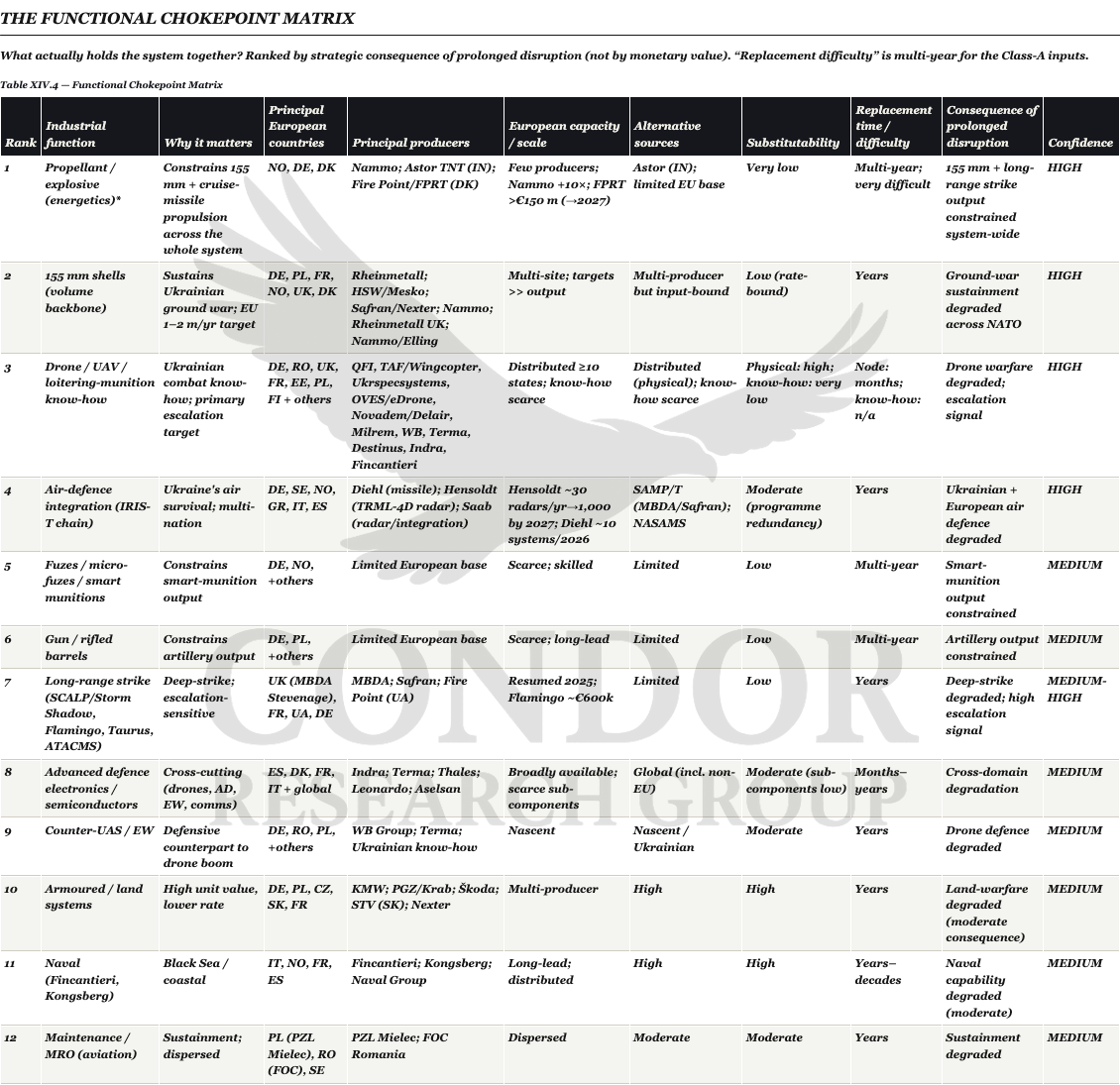
Figure 1. Functional Chokepoint Matrix
The matrix identifies three functions at the highest level of systemic exposure.
First is propellant and explosive production. These inputs constrain artillery ammunition and cruise-missile propulsion across multiple downstream systems. Production remains concentrated, technically demanding and difficult to substitute rapidly. Replacement capacity is measured in years rather than months.
Second is 155 mm ammunition production. Europe has substantially expanded shell-manufacturing capacity, but the system remains constrained by upstream inputs and rate-bound production processes. Additional assembly capacity does not automatically remove energetic, fuze or barrel bottlenecks.
Third is drone and loitering-munition know-how. Here the vulnerability is different. Physical production is comparatively distributed and substitutable. Operationally relevant knowledge, rapid battlefield iteration and Ukrainian-derived engineering experience are considerably less substitutable.
The distinction is important:
A factory can sometimes be duplicated faster than an industrial ecosystem can be recreated.
⸻
2. The Node Problem
Functional analysis becomes more significant when translated into individual production nodes.
Europe’s defence industry is multinational in output but considerably more concentrated at facility level. Particular plants perform functions that cannot necessarily be replaced by another company’s nominally similar production line.
Ownership further complicates this picture.
A facility may be geographically located in one NATO state, owned by a company headquartered in another, dependent upon technology originating in a third, participate in a Ukrainian joint venture and receive public financing from several governments simultaneously.
The conventional national-defence-industrial map consequently understates the degree of cross-border dependency.
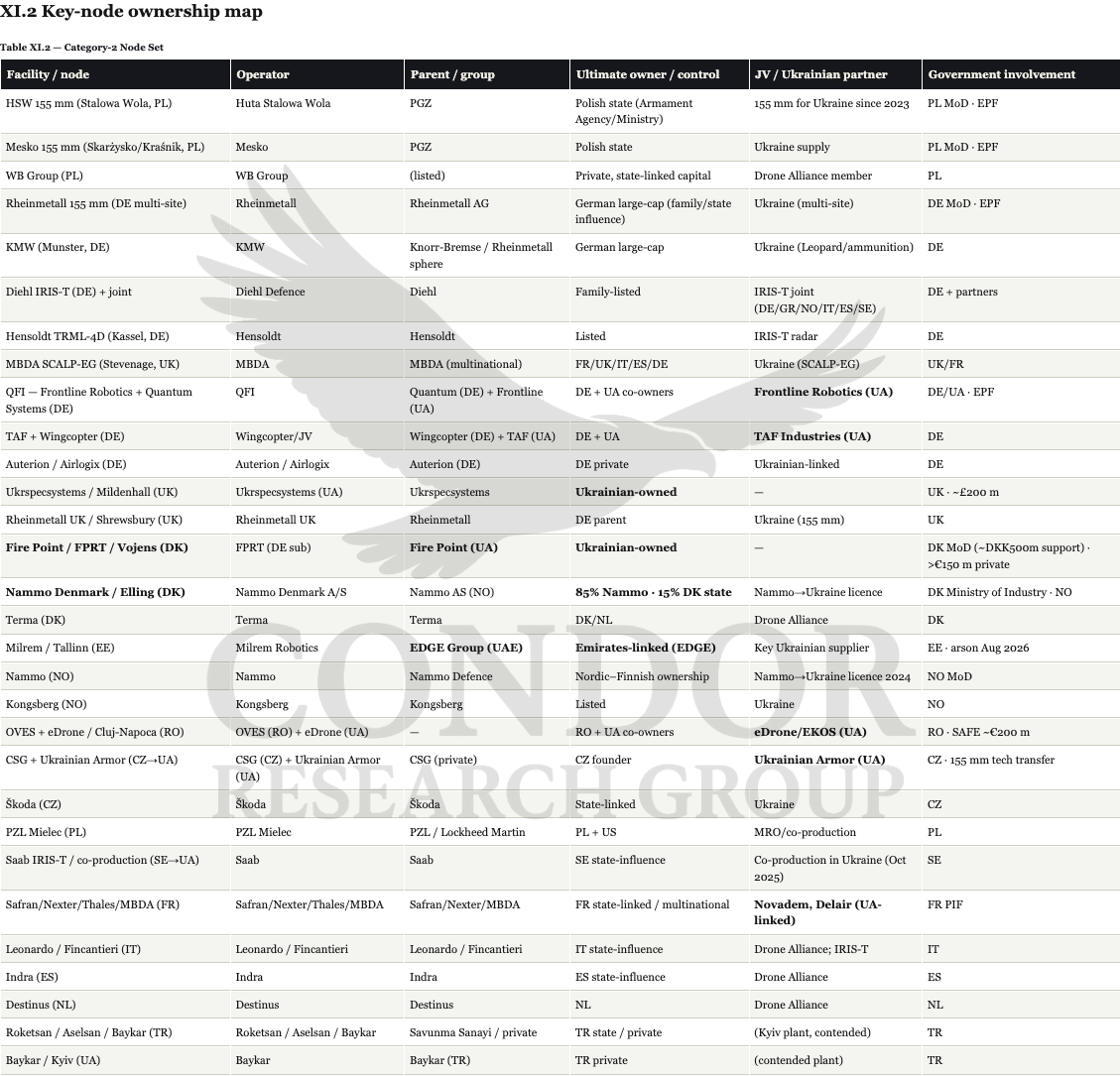
Figure 2. Key-Node Ownership Map
The ownership map demonstrates the density of these relationships.
Polish 155 mm production connects state-controlled PGZ facilities with Ukraine supply programmes. German industrial capacity connects Rheinmetall, Diehl, Hensoldt and other producers to ammunition, armoured systems and air-defence architectures. British nodes connect Ukrainian-owned drone production with long-range strike manufacturing. Scandinavian production links Norwegian, Danish and Swedish industrial capacity through ammunition, energetics, sensors and air defence.
Denmark is particularly illustrative.
Fire Point/FPRT at Vojens introduces a Ukrainian-owned energetic-material node onto Danish territory. Nammo Denmark/Elling combines Norwegian industrial control with a Danish state holding. Terma participates in wider European defence-electronics and unmanned-system architectures.
The strategic unit is therefore increasingly neither the company nor the state. It is the node-chain.
⸻
3. Weapon Production Reveals the Dependency Structure
Looking at weapons as finished products can conceal the dependency structure underneath them.
A 155 mm artillery shell, for example, is not simply a shell-production problem. It is the product of explosives, propellant, metallurgy, barrel life, fuze availability, machine tooling, transport, storage and final assembly.
Air defence presents a different configuration. Missile production, radar manufacturing, command integration and multinational programme participation create a chain in which redundancy may exist at the programme level while remaining limited at particular technical nodes.
Long-range strike introduces another characteristic: industrial scarcity combined with political escalation sensitivity.
Drone production produces almost the inverse structure: many potential physical manufacturers but a smaller pool of organisations possessing current battlefield-derived knowledge.
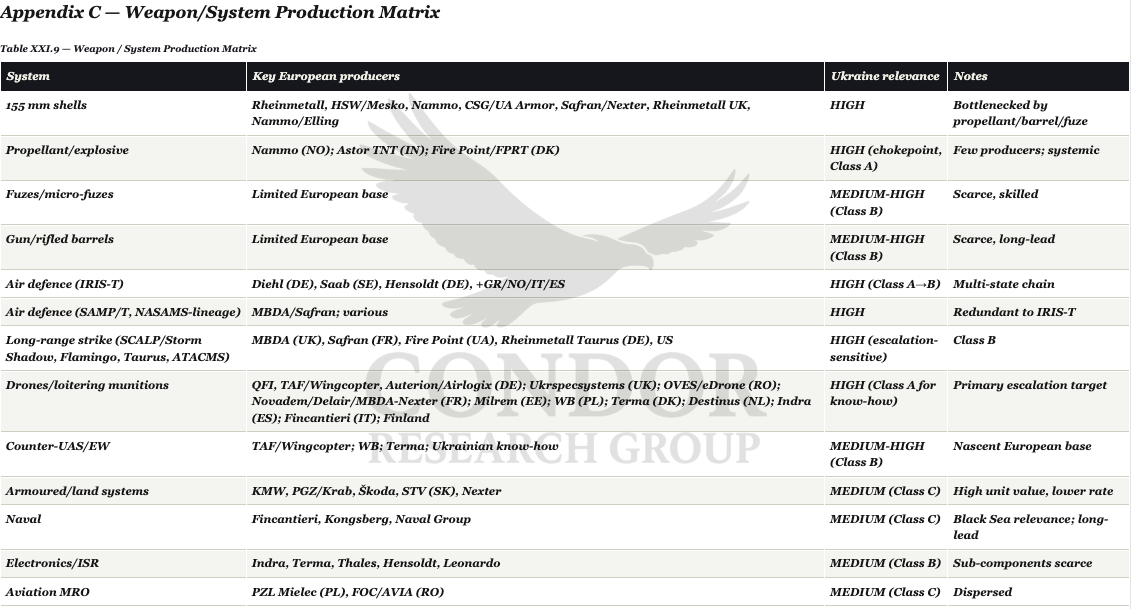
Figure 3. Weapon/System Production Matrix
The production matrix shows why measuring European defence capacity exclusively by prime contractors is inadequate.
Several strategically significant vulnerabilities sit beneath the prime-contractor layer. The most important components may not be the most expensive components. The largest company may not operate the most consequential facility. And the destruction or prolonged disabling of a comparatively small upstream node can impose output losses across several much larger downstream manufacturers.
This creates what CRG defines as systemic industrial leverage:
the capacity of disruption at one node to generate disproportionate degradation elsewhere in the defence-production network.
⸻
4. From Industrial Importance to Exposure
A chokepoint is not automatically a likely target.
Strategic exposure emerges from the interaction of several variables:
industrial consequence × substitutability × concentration × adversary attention × accessibility × political cost of disruption.
This distinction prevents the analysis from degenerating into a simple catalogue of important factories. Some high-value nodes possess substantial redundancy. Others are difficult to reach. Some have already attracted hostile intelligence attention or suspected disruptive activity. Others have not.
CRG therefore separates functional importance from exposure priority.
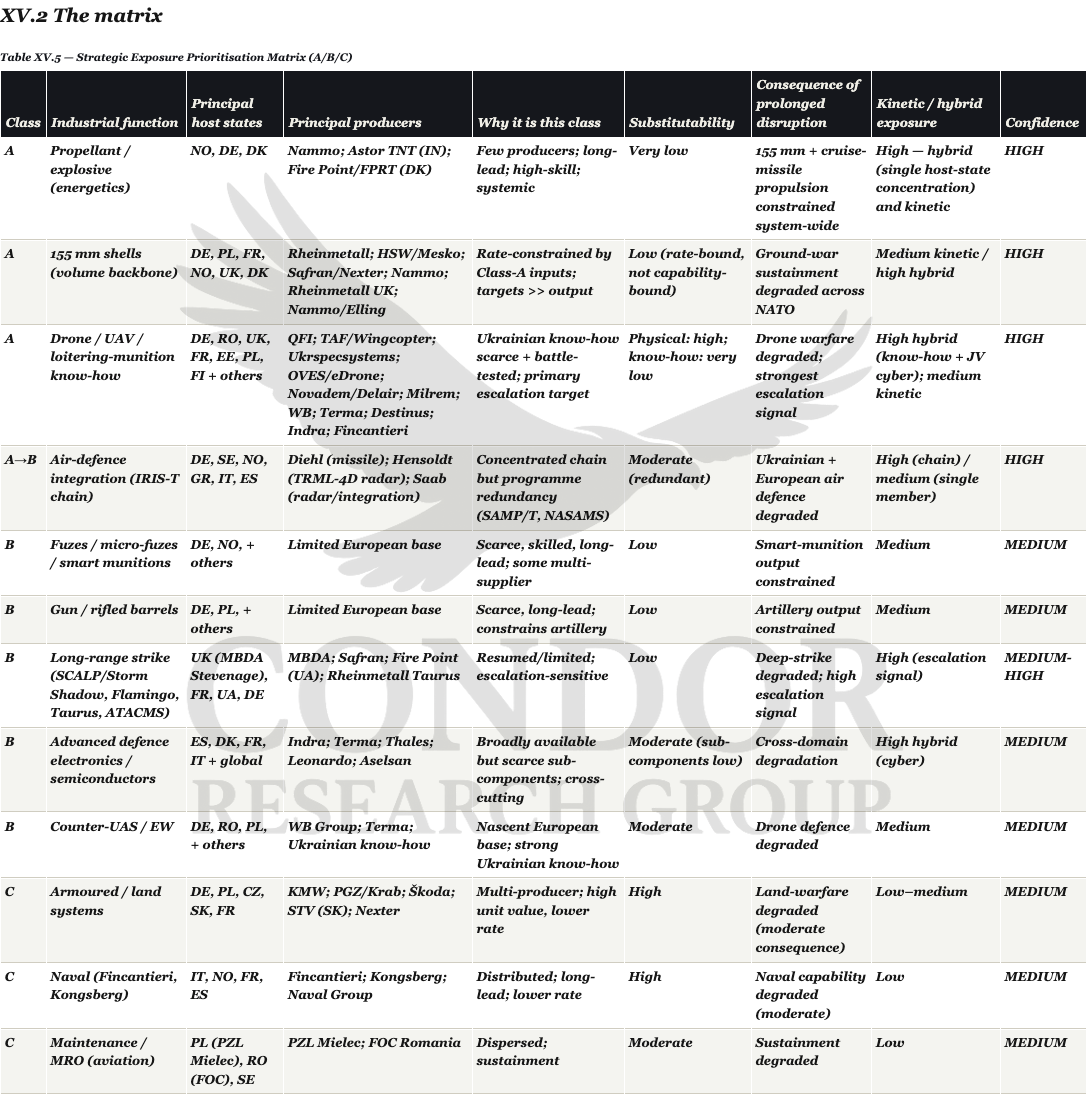
Figure 4. Strategic Exposure Prioritisation Matrix
Class A contains functions where prolonged disruption could generate system-wide effects or remove capabilities that are difficult to regenerate within the relevant conflict horizon.
Class B represents serious but more bounded vulnerabilities.
Class C contains important industrial capacity whose loss would degrade military output but where substitution, distributed production or lower production rates reduce systemic consequences.
This classification also distinguishes between kinetic and hybrid exposure. That distinction matters considerably in Europe. A production facility does not need to be destroyed to become unavailable.
Fire, sabotage, cyber intrusion, compromised industrial control systems, contamination, power disruption, transport interference, espionage, component manipulation, workforce intimidation, regulatory obstruction or apparently ordinary industrial accidents can all produce operationally significant downtime.
The threshold for disrupting production is consequently much lower than the threshold for physically eliminating a facility.
⸻
5. The Geography of Exposure
Once industrial depth and exposure are combined, the European map changes again.
Large states remain important, but geographic size and total defence expenditure cease to be sufficient measures.
Germany ranks first because of the breadth and depth of its defence-industrial position: ammunition, air defence, land systems, sensors, drones and integration functions intersect within the German industrial base.
Poland follows because of industrial diversification combined with its logistical and geographic position on NATO’s eastern flank.
Denmark ranks unusually high relative to its size because several characteristics converge: energetic-material production, ammunition interests, defence electronics, Ukrainian industrial participation and the political symbolism associated with hosting strategically relevant production.
The United Kingdom combines long-range strike production with Ukrainian drone-industrial nodes.
Estonia and Romania illustrate another phenomenon: states with smaller overall industrial bases can acquire disproportionate exposure through particular facilities, foreign ownership structures, geographic proximity or previous hostile activity.
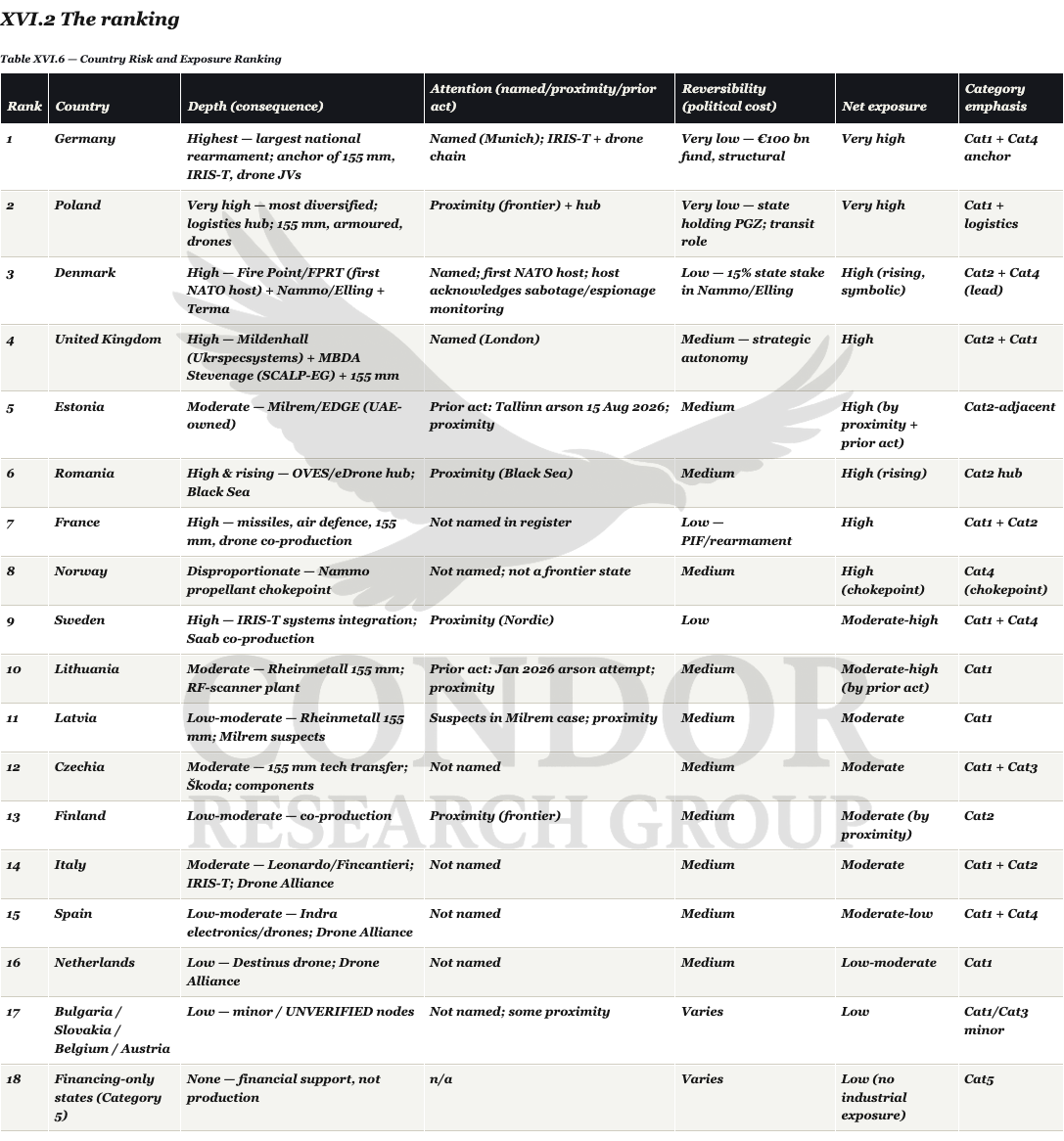
Figure 5. Country Risk and Exposure Ranking
The ranking should not be interpreted as a prediction that specific states or facilities will be attacked.
It represents structural exposure.
Germany and Poland possess the greatest aggregate depth. Denmark presents a smaller but unusually concentrated profile. Norway’s importance derives substantially from an energetic-material chokepoint. Sweden combines air-defence integration and co-production. France retains substantial depth but also greater national redundancy.
At the lower end of the ranking, several states contribute meaningful production without currently constituting systemic European chokepoints. This produces a defence-industrial geography substantially different from a map based upon military expenditure.
⸻
6. Denmark: Small State, Disproportionate Node Value
Denmark warrants particular attention because its position illustrates the transformation now occurring across Europe’s defence-industrial landscape.
Its strategic exposure is not generated primarily by the size of the Danish armed forces. It derives from the functions now located within Danish territory.
Energetic-material production is intrinsically sensitive because explosives and propellants sit upstream of multiple weapons categories. Nammo/Elling introduces another ammunition-related node. Terma contributes specialised electronics and defence integration. Danish participation in wider European and Ukrainian production networks further increases connectivity.
The consequence is counterintuitive. A relatively small NATO member can become more strategically consequential, and therefore more exposed, without substantially increasing the size of its armed forces.
Industrial geography changes strategic geography. This effect will become more pronounced as European governments deliberately distribute Ukrainian-linked production across NATO territory.
⸻
7. Ukrainian Industrial Integration Changes the Target Architecture
The integration of Ukrainian companies and technical knowledge into European production is strategically rational.
It distributes manufacturing beyond Ukrainian territory, provides access to European capital and infrastructure, preserves technical expertise and accelerates incorporation of battlefield experience into Western production.
It also changes the architecture of exposure. The industrial boundary of the Russia–Ukraine war no longer corresponds neatly with Ukraine’s territorial boundary. Ukrainian-owned companies, joint ventures, technical teams, intellectual property, production lines and supply relationships increasingly exist inside NATO states.
This does not mean that every Ukrainian-linked European facility becomes a target. It means that the distinction between Ukrainian military production and European military production supporting Ukraine is becoming structurally less meaningful. From a systems perspective, they increasingly form one network.
⸻
8. The Hybrid Vulnerability Is Greater Than the Kinetic Vulnerability
For most European nodes, overt kinetic attack remains the politically expensive method of disruption.
Hybrid methods offer a substantially wider operating space.
And critically, industrial systems contain numerous points where relatively limited interference can generate disproportionate downtime. The most exposed facilities are therefore not necessarily those easiest to destroy. They are those easiest to interrupt.
That difference should shape counterintelligence, physical security, cybersecurity, supply-chain auditing, workforce screening, fire protection, redundancy planning and national infrastructure policy.
⸻
9. The Rearmament Paradox
Europe is increasing defence production precisely as its defence-industrial system becomes more interconnected. That produces a paradox. Greater aggregate capacity can coexist with greater systemic dependency.
New factories increase output. Joint ventures accelerate production. Cross-border integration improves efficiency. Ukrainian expertise improves battlefield relevance. But every new dependency also creates another connection through which disruption can propagate. The objective should therefore not simply be more capacity.
It should be capacity with graceful degradation. A resilient defence-industrial architecture should be capable of losing individual plants, suppliers, transport corridors, data systems or technical teams without producing cascading failure elsewhere.
This requires deliberate duplication of functions that conventional commercial logic would often regard as inefficient. Strategic redundancy is economically inefficient by design. That is precisely why it exists.
⸻
10. Assessment
CRG assesses that the European defence-industrial system is stronger in aggregate production capacity than it was at the beginning of the Russia–Ukraine war, but remains structurally concentrated in several upstream functions.
The principal vulnerability is not the loss of a major prime contractor. It is prolonged disruption of a limited number of high-leverage industrial nodes whose outputs or technical competencies are difficult to substitute within wartime timescales.
Energetic materials constitute the clearest systemic chokepoint.
155 mm ammunition remains heavily dependent upon upstream constraints despite substantial capacity expansion. Drone production is physically distributed but retains significant concentration of battlefield-relevant knowledge. Air defence possesses multinational redundancy but remains dependent upon specialised integration chains. Long-range strike remains comparatively scarce and politically escalation-sensitive.
European rearmament has therefore entered a second phase. The first problem was insufficient production. The emerging problem is ensuring that expanded production cannot be selectively disabled. The distinction is fundamental.
Production capacity determines how much Europe can manufacture.
Industrial resilience determines how much of that capacity survives contact with an adversary.
And in a prolonged conflict, the second variable may ultimately matter more than the first.
DOCUMENT INFORMATION
Document: CRG-EUR-INT-0826/3: Europe’s Defence-Industrial Chokepoints – Strategic Exposure, Node Concentration, and the Geography of Disruption
Classification: Strategic Intelligence Assessment (Defence-Industrial Exposure Analysis)
Distribution: Public Release
Revision Status: Final — Approved for internal CRG circulation, external academic reference, and web publication
Authorized By: Condor Research Group (CRG)
Division: Geopolitical & Strategic Intelligence Division
Original Draft Date: August 2026
Release Date: 29 August 2026
Version: CRG-INT-VER-A1-FINAL
Keywords: Europe, European Defence Industry, Defence-Industrial Base, Defence Production, Industrial Resilience, Strategic Chokepoints, Supply-Chain Vulnerability, Energetic Materials, Propellants, Explosives, 155 mm Ammunition, Air Defence, IRIS-T, Long-Range Strike, UAVs, Drone Production, Ukraine, NATO, Germany, Poland, Denmark, United Kingdom, Norway, Sweden, Hybrid Threats, Industrial Sabotage, Strategic Exposure, Defence Supply Chains
Source Report: European Defence-Industrial Chokepoints: Functional Dependency, Strategic Exposure and the Geography of Disruption
Publication Note: Published on the Condor Research Group website as part of the CRG Strategic Intelligence Assessment series. This assessment examines structural dependencies, functional chokepoints, ownership relationships, substitutability and national exposure within the European defence-industrial system. Rankings and classifications represent comparative analytical assessments of the consequences of prolonged disruption and do not constitute predictions of hostile action against any identified state, company, facility or industrial node. The analysis distinguishes industrial importance from exposure and evaluates systemic resilience rather than the operational feasibility of attacking individual facilities.
Title: Europe’s Defence-Industrial Chokepoints
Subtitle: Strategic Exposure, Node Concentration, and the Geography of Disruption
Classification: UNCLASSIFIED
Date: 29 August 2026
Publisher: Condor Research Group (CRG)
European rearmament is generally discussed in terms of aggregate expenditure, production targets, procurement programmes, and the number of weapons systems entering service. Those measures describe scale. They do not necessarily describe resilience.
A defence-industrial system can possess substantial nominal capacity while remaining structurally vulnerable if a small number of industrial functions, facilities, technical competencies, or national production nodes cannot be replaced within the operational timescale of a conflict.
The relevant analytical question is therefore:
Which parts of European military production cannot be interrupted without degrading the wider system?
CRG’s examination of the European defence-industrial architecture identifies a relatively small set of functions whose strategic importance is disproportionate to their monetary value or physical footprint. These include energetic materials, artillery ammunition inputs, specialised fuzes and barrels, air-defence integration, long-range strike production and, increasingly, the industrial knowledge networks supporting unmanned systems.
The resulting structure is not a conventional supply chain. It is better understood as a network of functional chokepoints.
⸻
1. Capacity Is Not the Same as Resilience
European defence production has expanded significantly in response to the Russia–Ukraine war. New plants are being constructed, dormant production lines restarted, multinational programmes expanded and governments are underwriting additional capacity.
This expansion can obscure an important distinction.
Production volume measures what the system can manufacture under functioning conditions. Resilience measures what remains possible after individual nodes are disrupted.
These are different variables.
A system producing two million artillery rounds annually may appear substantially more resilient than one producing one million. That conclusion becomes questionable if both production systems ultimately depend upon a small number of energetic-material plants, specialised fuze manufacturers or barrel-production facilities.
In such circumstances, upstream concentration becomes more strategically important than downstream volume.
CRG therefore ranks industrial functions according to the consequence of prolonged disruption, rather than revenue, company size, employment or political prominence. The result produces a different map of European defence importance.
Figure 1. Functional Chokepoint Matrix
The matrix identifies three functions at the highest level of systemic exposure.
First is propellant and explosive production. These inputs constrain artillery ammunition and cruise-missile propulsion across multiple downstream systems. Production remains concentrated, technically demanding and difficult to substitute rapidly. Replacement capacity is measured in years rather than months.
Second is 155 mm ammunition production. Europe has substantially expanded shell-manufacturing capacity, but the system remains constrained by upstream inputs and rate-bound production processes. Additional assembly capacity does not automatically remove energetic, fuze or barrel bottlenecks.
Third is drone and loitering-munition know-how. Here the vulnerability is different. Physical production is comparatively distributed and substitutable. Operationally relevant knowledge, rapid battlefield iteration and Ukrainian-derived engineering experience are considerably less substitutable.
The distinction is important:
A factory can sometimes be duplicated faster than an industrial ecosystem can be recreated.
⸻
2. The Node Problem
Functional analysis becomes more significant when translated into individual production nodes.
Europe’s defence industry is multinational in output but considerably more concentrated at facility level. Particular plants perform functions that cannot necessarily be replaced by another company’s nominally similar production line.
Ownership further complicates this picture.
A facility may be geographically located in one NATO state, owned by a company headquartered in another, dependent upon technology originating in a third, participate in a Ukrainian joint venture and receive public financing from several governments simultaneously.
The conventional national-defence-industrial map consequently understates the degree of cross-border dependency.
Figure 2. Key-Node Ownership Map
The ownership map demonstrates the density of these relationships.
Polish 155 mm production connects state-controlled PGZ facilities with Ukraine supply programmes. German industrial capacity connects Rheinmetall, Diehl, Hensoldt and other producers to ammunition, armoured systems and air-defence architectures. British nodes connect Ukrainian-owned drone production with long-range strike manufacturing. Scandinavian production links Norwegian, Danish and Swedish industrial capacity through ammunition, energetics, sensors and air defence.
Denmark is particularly illustrative.
Fire Point/FPRT at Vojens introduces a Ukrainian-owned energetic-material node onto Danish territory. Nammo Denmark/Elling combines Norwegian industrial control with a Danish state holding. Terma participates in wider European defence-electronics and unmanned-system architectures.
The strategic unit is therefore increasingly neither the company nor the state. It is the node-chain.
⸻
3. Weapon Production Reveals the Dependency Structure
Looking at weapons as finished products can conceal the dependency structure underneath them.
A 155 mm artillery shell, for example, is not simply a shell-production problem. It is the product of explosives, propellant, metallurgy, barrel life, fuze availability, machine tooling, transport, storage and final assembly.
Air defence presents a different configuration. Missile production, radar manufacturing, command integration and multinational programme participation create a chain in which redundancy may exist at the programme level while remaining limited at particular technical nodes.
Long-range strike introduces another characteristic: industrial scarcity combined with political escalation sensitivity.
Drone production produces almost the inverse structure: many potential physical manufacturers but a smaller pool of organisations possessing current battlefield-derived knowledge.
Figure 3. Weapon/System Production Matrix
The production matrix shows why measuring European defence capacity exclusively by prime contractors is inadequate.
Several strategically significant vulnerabilities sit beneath the prime-contractor layer. The most important components may not be the most expensive components. The largest company may not operate the most consequential facility. And the destruction or prolonged disabling of a comparatively small upstream node can impose output losses across several much larger downstream manufacturers.
This creates what CRG defines as systemic industrial leverage:
the capacity of disruption at one node to generate disproportionate degradation elsewhere in the defence-production network.
⸻
4. From Industrial Importance to Exposure
A chokepoint is not automatically a likely target.
Strategic exposure emerges from the interaction of several variables:
industrial consequence × substitutability × concentration × adversary attention × accessibility × political cost of disruption.
This distinction prevents the analysis from degenerating into a simple catalogue of important factories. Some high-value nodes possess substantial redundancy. Others are difficult to reach. Some have already attracted hostile intelligence attention or suspected disruptive activity. Others have not.
CRG therefore separates functional importance from exposure priority.
Figure 4. Strategic Exposure Prioritisation Matrix
Class A contains functions where prolonged disruption could generate system-wide effects or remove capabilities that are difficult to regenerate within the relevant conflict horizon.
Class B represents serious but more bounded vulnerabilities.
Class C contains important industrial capacity whose loss would degrade military output but where substitution, distributed production or lower production rates reduce systemic consequences.
This classification also distinguishes between kinetic and hybrid exposure. That distinction matters considerably in Europe. A production facility does not need to be destroyed to become unavailable.
Fire, sabotage, cyber intrusion, compromised industrial control systems, contamination, power disruption, transport interference, espionage, component manipulation, workforce intimidation, regulatory obstruction or apparently ordinary industrial accidents can all produce operationally significant downtime.
The threshold for disrupting production is consequently much lower than the threshold for physically eliminating a facility.
⸻
5. The Geography of Exposure
Once industrial depth and exposure are combined, the European map changes again.
Large states remain important, but geographic size and total defence expenditure cease to be sufficient measures.
Germany ranks first because of the breadth and depth of its defence-industrial position: ammunition, air defence, land systems, sensors, drones and integration functions intersect within the German industrial base.
Poland follows because of industrial diversification combined with its logistical and geographic position on NATO’s eastern flank.
Denmark ranks unusually high relative to its size because several characteristics converge: energetic-material production, ammunition interests, defence electronics, Ukrainian industrial participation and the political symbolism associated with hosting strategically relevant production.
The United Kingdom combines long-range strike production with Ukrainian drone-industrial nodes.
Estonia and Romania illustrate another phenomenon: states with smaller overall industrial bases can acquire disproportionate exposure through particular facilities, foreign ownership structures, geographic proximity or previous hostile activity.
Figure 5. Country Risk and Exposure Ranking
The ranking should not be interpreted as a prediction that specific states or facilities will be attacked.
It represents structural exposure.
Germany and Poland possess the greatest aggregate depth. Denmark presents a smaller but unusually concentrated profile. Norway’s importance derives substantially from an energetic-material chokepoint. Sweden combines air-defence integration and co-production. France retains substantial depth but also greater national redundancy.
At the lower end of the ranking, several states contribute meaningful production without currently constituting systemic European chokepoints. This produces a defence-industrial geography substantially different from a map based upon military expenditure.
⸻
6. Denmark: Small State, Disproportionate Node Value
Denmark warrants particular attention because its position illustrates the transformation now occurring across Europe’s defence-industrial landscape.
Its strategic exposure is not generated primarily by the size of the Danish armed forces. It derives from the functions now located within Danish territory.
Energetic-material production is intrinsically sensitive because explosives and propellants sit upstream of multiple weapons categories. Nammo/Elling introduces another ammunition-related node. Terma contributes specialised electronics and defence integration. Danish participation in wider European and Ukrainian production networks further increases connectivity.
The consequence is counterintuitive. A relatively small NATO member can become more strategically consequential, and therefore more exposed, without substantially increasing the size of its armed forces.
Industrial geography changes strategic geography. This effect will become more pronounced as European governments deliberately distribute Ukrainian-linked production across NATO territory.
⸻
7. Ukrainian Industrial Integration Changes the Target Architecture
The integration of Ukrainian companies and technical knowledge into European production is strategically rational.
It distributes manufacturing beyond Ukrainian territory, provides access to European capital and infrastructure, preserves technical expertise and accelerates incorporation of battlefield experience into Western production.
It also changes the architecture of exposure. The industrial boundary of the Russia–Ukraine war no longer corresponds neatly with Ukraine’s territorial boundary. Ukrainian-owned companies, joint ventures, technical teams, intellectual property, production lines and supply relationships increasingly exist inside NATO states.
This does not mean that every Ukrainian-linked European facility becomes a target. It means that the distinction between Ukrainian military production and European military production supporting Ukraine is becoming structurally less meaningful. From a systems perspective, they increasingly form one network.
⸻
8. The Hybrid Vulnerability Is Greater Than the Kinetic Vulnerability
For most European nodes, overt kinetic attack remains the politically expensive method of disruption.
Hybrid methods offer a substantially wider operating space.
- They permit ambiguity.
- They permit calibration.
- They permit repeated probing.
- They can impose costs below the threshold at which governments are prepared to attribute responsibility or invoke collective-defence mechanisms.
And critically, industrial systems contain numerous points where relatively limited interference can generate disproportionate downtime. The most exposed facilities are therefore not necessarily those easiest to destroy. They are those easiest to interrupt.
That difference should shape counterintelligence, physical security, cybersecurity, supply-chain auditing, workforce screening, fire protection, redundancy planning and national infrastructure policy.
⸻
9. The Rearmament Paradox
Europe is increasing defence production precisely as its defence-industrial system becomes more interconnected. That produces a paradox. Greater aggregate capacity can coexist with greater systemic dependency.
New factories increase output. Joint ventures accelerate production. Cross-border integration improves efficiency. Ukrainian expertise improves battlefield relevance. But every new dependency also creates another connection through which disruption can propagate. The objective should therefore not simply be more capacity.
It should be capacity with graceful degradation. A resilient defence-industrial architecture should be capable of losing individual plants, suppliers, transport corridors, data systems or technical teams without producing cascading failure elsewhere.
This requires deliberate duplication of functions that conventional commercial logic would often regard as inefficient. Strategic redundancy is economically inefficient by design. That is precisely why it exists.
⸻
10. Assessment
CRG assesses that the European defence-industrial system is stronger in aggregate production capacity than it was at the beginning of the Russia–Ukraine war, but remains structurally concentrated in several upstream functions.
The principal vulnerability is not the loss of a major prime contractor. It is prolonged disruption of a limited number of high-leverage industrial nodes whose outputs or technical competencies are difficult to substitute within wartime timescales.
Energetic materials constitute the clearest systemic chokepoint.
155 mm ammunition remains heavily dependent upon upstream constraints despite substantial capacity expansion. Drone production is physically distributed but retains significant concentration of battlefield-relevant knowledge. Air defence possesses multinational redundancy but remains dependent upon specialised integration chains. Long-range strike remains comparatively scarce and politically escalation-sensitive.
European rearmament has therefore entered a second phase. The first problem was insufficient production. The emerging problem is ensuring that expanded production cannot be selectively disabled. The distinction is fundamental.
Production capacity determines how much Europe can manufacture.
Industrial resilience determines how much of that capacity survives contact with an adversary.
And in a prolonged conflict, the second variable may ultimately matter more than the first.
DOCUMENT INFORMATION
Document: CRG-EUR-INT-0826/3: Europe’s Defence-Industrial Chokepoints – Strategic Exposure, Node Concentration, and the Geography of Disruption
Classification: Strategic Intelligence Assessment (Defence-Industrial Exposure Analysis)
Distribution: Public Release
Revision Status: Final — Approved for internal CRG circulation, external academic reference, and web publication
Authorized By: Condor Research Group (CRG)
Division: Geopolitical & Strategic Intelligence Division
Original Draft Date: August 2026
Release Date: 29 August 2026
Version: CRG-INT-VER-A1-FINAL
Keywords: Europe, European Defence Industry, Defence-Industrial Base, Defence Production, Industrial Resilience, Strategic Chokepoints, Supply-Chain Vulnerability, Energetic Materials, Propellants, Explosives, 155 mm Ammunition, Air Defence, IRIS-T, Long-Range Strike, UAVs, Drone Production, Ukraine, NATO, Germany, Poland, Denmark, United Kingdom, Norway, Sweden, Hybrid Threats, Industrial Sabotage, Strategic Exposure, Defence Supply Chains
Source Report: European Defence-Industrial Chokepoints: Functional Dependency, Strategic Exposure and the Geography of Disruption
Publication Note: Published on the Condor Research Group website as part of the CRG Strategic Intelligence Assessment series. This assessment examines structural dependencies, functional chokepoints, ownership relationships, substitutability and national exposure within the European defence-industrial system. Rankings and classifications represent comparative analytical assessments of the consequences of prolonged disruption and do not constitute predictions of hostile action against any identified state, company, facility or industrial node. The analysis distinguishes industrial importance from exposure and evaluates systemic resilience rather than the operational feasibility of attacking individual facilities.